Quick answer: A good letter to Santa has four parts: the child's name and age, one kind thing they did this year, a short wish list with the favourite first, and a thank-you. Pick the template below that fits your child's age, fill it in together, and post or hide it by early December so it lands before the big night.
Pick the template by age, not by cuteness
The prettiest template is not always the right one. A four-year-old faced with ten blank lines will draw on the border and give up. A nine-year-old given a fill-in-the-blank sheet will feel babied. Match the page to what your child can actually do, and the letter writes itself.
If you need a matching set with all four levels already laid out, the printables page holds the Cards, Gift Tags and Santa Letters Bundle for $3, which carries letter sheets, gift tags and cards in one design. The four letters below are complete on their own, no purchase needed.
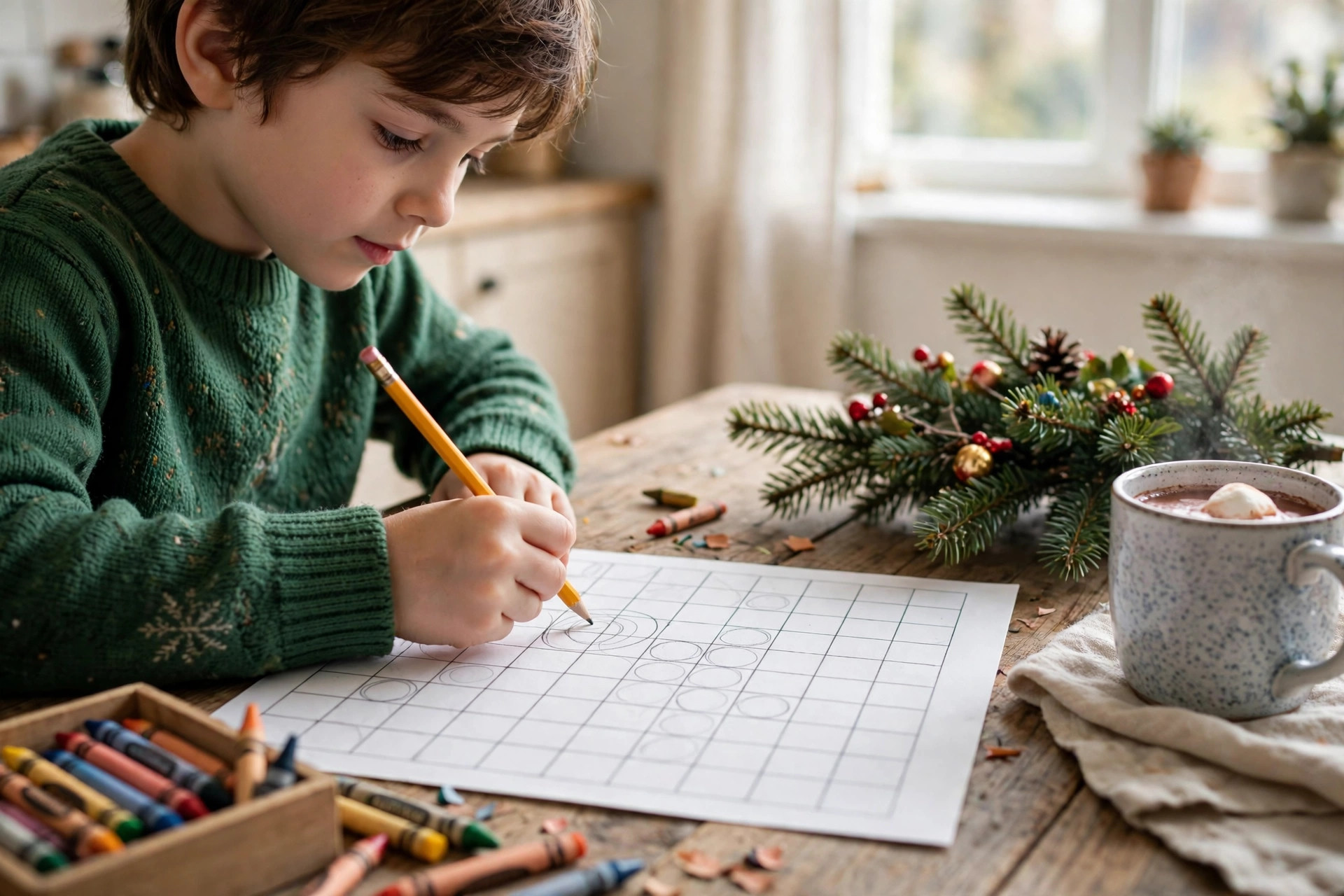
- Ages 3 to 5: draw-and-write. One line for the name, then a big box to draw the wish. The drawing is the letter.
- Ages 5 to 7: fill-in-the-blank. Short prompts, short answers, no long writing required.
- Ages 6 to 8: handwriting lines. Ruled lines with a little space to think, plus a box for ideas.
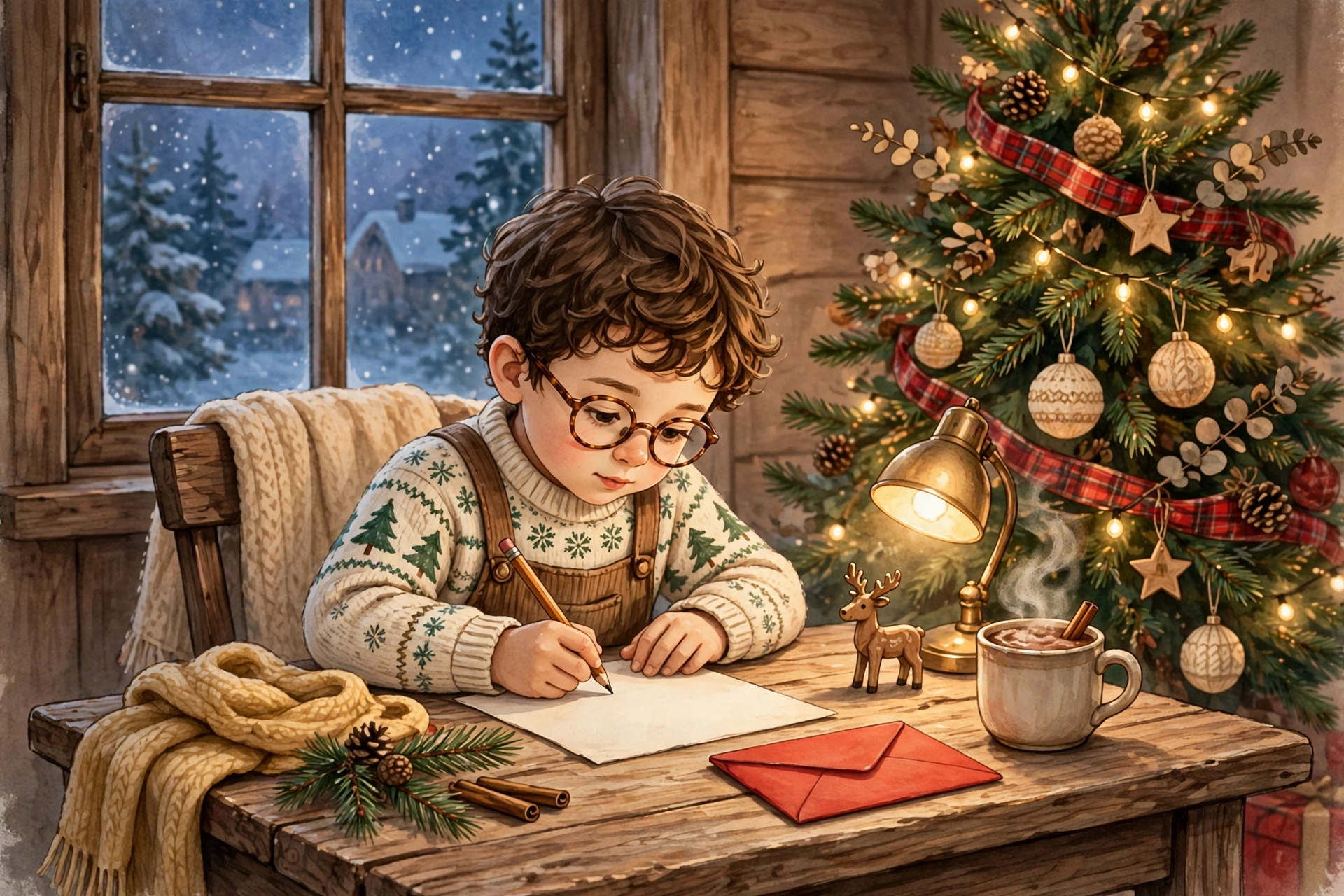
- Ages 8 and up: free-write stationery. Festive paper, ruled lines, no prompts. Older children want to sound like themselves.
Template 1: draw-and-write, ages 3 to 5
Dear Santa, My name is ____. I am ____ years old. This year I was kind when I ____. [Big drawing box here: draw your wish] Thank you, Santa! Love, ____. Sit beside them and let them tell you what they drew. Write their words under the picture in small letters if they ask you to. That caption is what grandparents will read out loud for years.
Do not worry if the drawing looks nothing like the wish. A page of enthusiastic orange scribble may be a bicycle, a dinosaur or a pair of socks, and only the artist knows. That is exactly why the caption matters. Ask once, write down their exact words, and resist tidying their sentence into adult grammar. "A dragon what is friendly and not fire on houses" is a better keepsake, and a clearer shopping clue once you decode it together, than any corrected version. If they want to draw a second wish on the back, let them. The front stays the letter. The back is pure bonus.
Template 2: fill-in-the-blank, ages 5 to 7
Dear Santa, My name is ____ and I am ____ years old. This year I tried hard at ____. I was kind when I ____. For Christmas I would love: 1. ____ 2. ____ 3. ____. My wish for someone else is ____. My question for you is ____. Thank you for visiting every year. Love, ____. Keep the wish list to three. Three wishes teach a child to choose, and they save you from a page of twenty toys that no one can deliver. Put the favourite first, and tell your child that Santa picks from the list, he does not buy the whole list.
Template 3: handwriting lines, ages 6 to 8
Dear Santa, I have been thinking about Christmas, and I wanted to write to you myself. This year I am proud of ____. At home I helped by ____. My three wishes are ____, ____ and ____, and I would like ____ most of all, because ____. Thank you for the reindeer and the elves and all the work at the North Pole. Love, ____. This is the version for children learning to write properly. The "because" matters. It turns a list into a letter, and it gives Santa, and you, something real to answer.
Template 4: free-write, ages 8 and up
No prompts, just a start: "Dear Santa," and a blank page. If your child stalls, give them three quiet questions and walk away: what are you proud of this year, what do you actually want most, and what would you give someone else? Then let them write it in their own words, spelling mistakes and all. A letter that sounds like your child is worth more than a perfect one that sounds like a worksheet. For the reply side of this tradition, our Letter From Santa guide gives you three letters Santa can write back, so the two letters tell one story across December.
How to print it so it survives small hands
Print on ordinary paper, one page per child. If your printer has a draft or greyscale mode, use it for practice copies and save the colour for the final one. Let the child decorate the border after writing, not before, or the crayons eat the writing space. Fold it once, put it in an envelope, and write the child's name on the front in your best handwriting. Children check the envelope first. One more practical point: print a second copy before it goes anywhere. The original goes to Santa. The copy is what the rest of the family shops from, so grandparents do not buy the same toy twice.
A word about pens, learned the hard way in many kitchens: give a young child a washable felt-tip or a thick pencil for the letter itself, and save the glitter pens for the border afterwards. Glitter ink smudges under a sleeve, bleeds through thin paper, and turns a proud signature into a sparkly smear. If your child presses hard when they write, slip a piece of card under the page so the lines do not emboss the table or tear through on the last, most important word. And if the first attempt ends in tears over one spoiled letter, simply print another copy without comment. A fresh page, offered calmly, teaches them that drafts are normal. Writers start again all the time.
Posting it for real, and the dates that matter
In the United States, children can genuinely post a letter to Santa through the Postal Service's long-running programme. The USPS Operation Santa announcement explains the 2026 season: letters go to Santa Claus, 123 Elf Road, North Pole, 88888, and must be postmarked by 5 December to be eligible. There is no guarantee a letter is answered, so write your own reply letter as well, using the guide linked above, and treat any postal reply as a bonus. Outside the United States, check your own postal service's Santa programme before posting, because addresses and deadlines differ by country. If there is no programme where you live, the hidden-letter version works just as well: leave the letter in a stocking, by the advent calendar on 1 December, or leaning against the milk bottle, and let the child find it in the morning.
Three mistakes that spoil a good letter
First, promising a specific present in the reply. "You will get the bike" becomes a contract you may not be able to keep. "I have seen your list" keeps the magic without the obligation. Second, writing the whole letter yourself in adult words. Children can tell, and older ones will say so. Let the child's voice stay in it, even when the spelling wobbles. Third, using the letter as a behaviour threat. "Be good or else" turns Santa into a surveillance system, and it stops working the moment a child tests it. Praise something real instead.
A calm fifteen-minute writing routine that actually works
Most letters to Santa do not fail on the template. They fail on the timing: a tired child, a noisy room, a parent trying to cook dinner and supervise handwriting at the same time. Pick a quieter slot instead. After tea, before bath, lights warm, television off. Fifteen minutes is plenty, and saying so out loud helps: "We will write Santa's letter, then it is bath time." A small, known window feels safe to a child who finds writing hard work.
Set the table like a tiny post office. One printed page per child, a pencil, an eraser they are allowed to use without asking, and an envelope waiting, empty, where they can see it. The envelope is not decoration. It tells a child this letter is going somewhere, and it gives the whole task a finish line. Start by talking, not writing. Ask what they are proud of this year and listen for the answer in their words, because that sentence, copied down, will be the warmest line in the letter. Then do the wishes. Then the thank-you. Talk, write, talk, write, in short turns, and stop while it is still fun.
If a younger sibling is circling the table wanting a turn, give them their own draw-and-write page at the same time rather than making them wait and watch. Two children writing side by side, one drawing and one filling in blanks, argue far less than one child performing while the other is excluded. When the letters are done, let each child lick or stick their own envelope, write their name on the front, and choose where the letters wait until posting day: on the mantelpiece, under the tree, or in a special drawer. A letter that has a waiting place does not get lost under a pile of school newsletters, which is the fate of more Santa letters than anyone admits.
When the wish is impossible, enormous or a live animal
Sooner or later, a child writes a wish no one can deliver: a real pony, a baby brother by Christmas, a pet dragon, snow that lasts all year, or a toy that costs more than the family's whole December. Do not cross it out, and do not laugh, however tempting either reaction is in the moment. The wish is information. It tells you what the child is dreaming about, and the letter is the safest place in the world for a dream that size.
Handle it in the letter itself, with one gentle sentence you can help them add: "I know some wishes are tricky, so here is another idea I would love too." Then help them choose a smaller, deliverable wish that points in the same direction. A child asking for a pony might light up at a riding lesson voucher, a toy stable, or a book about horses with their name written inside. A child asking for a pet can sometimes be met halfway, over time and as a family decision, and the letter can simply say they would love to help choose pet supplies one day. What you are teaching, without a lecture, is how to want things in a way that leaves room for real life.
This is also why the reply letter matters so much. In our Nice List Certificate guide, the rule is the same as here: praise something true, promise nothing specific. Santa can be delighted by the big wish, amused by it, even a little wistful about the dragon, without ever agreeing to deliver it. If your child has their heart truly set on one thing and you already know it cannot happen, the kindest move is an honest, age-appropriate word from you, as yourself, well before Christmas Eve, separate from the letter entirely. Let Santa stay magical. Let the hard news come from a parent, kindly and early, with an alternative already in mind.
Helping a reluctant writer, a shy child or a child who dictates
Not every child wants to write, and a letter to Santa should never become the evening's battleground. Some children have so much to say that their hand cannot keep up. Some are shy about spelling. Some simply think better out loud, walking around the kitchen, than sitting still at a table. All of them deserve a letter that sounds like them.
Offer to be the scribe, openly and without any fuss. The child talks, you write their words exactly as they say them, and at the end they sign their own name at the bottom, in their own hand, however wobbly. That signature makes it their letter. Read it back to them before it goes in the envelope and change anything they want changed. A child who hears their own words read back, and gets to edit them, is doing real writing work. The handwriting was never the point.
For a shy child, a question can unlock more than a blank page does. Template 2 already includes "My question for you is ____", and shy children often fill that line first and longest: how do the reindeer fly in rain, does Santa sleep in January, who feeds the elves' cat? Let the letter lean into the question if that is where their energy is. A letter that is mostly a wonderful question, with one wish tucked underneath, is a complete letter. And for an older child who is starting to doubt but still wants to take part, offer the free-write page with no performance attached. Many of them write the most honest letters of all, half in on the joke and half still hoping, and those are the ones parents keep in a drawer for a decade.
Letters for a class, a party or cousins writing together
Writing letters in a group changes the energy completely. At a classroom table or a cousins' sleepover, children copy each other's wishes, compete over list length, and announce presents at full volume. A little structure keeps it joyful. Give everyone the same template level for their age, the same pens, and one shared rule stated at the start: three wishes each, favourite first, and one wish for someone else. That last wish, read around the table at the end if children want to share it, is usually the moment the whole activity turns warm.
Teachers, a practical note: send the letters home in envelopes rather than displaying them on a board. Wish lists reveal a great deal about family budgets, and a wall display quietly ranks children by what they asked for. A sealed envelope in a school bag keeps the magic and the privacy at the same time. If your class is also visited by an elf in December, our Elf on the Shelf Kit guide shows how letter-writing day can sit inside the wider December plan without doubling anyone's workload.
At home with cousins or friends, print spares without being asked. Someone will spoil a page, someone will want to start again because their cousin's drawing is better, and someone will finish in four minutes and demand a second letter "for the reindeer." Let them write it. Extra letters to reindeer, elves and Mrs Claus cost one sheet of paper each and are remembered, some years, better than the main event.
Keeping the letter safe: a short checklist for grown-ups
Once the envelope is sealed, the grown-up job begins, and it is mostly about not losing the most useful shopping list of the year. Work through these steps on the same evening, while the letter is still on the table.
- Photograph or scan the finished letter before it is posted or hidden, front and back, in case a second wish was drawn on the reverse.
- Note the favourite wish, the one listed first, somewhere private that you and any gift-buying partner can both check.
- Share the copy, not the original, with grandparents or relatives who ask what to buy, so two people do not buy the same gift.
- Write your reply letter within a few days, while the child's exact words and questions are still fresh in your mind.
- Keep one copy for the family memory box after Christmas, dated with the year, alongside a school photo from the same term if you have one.
Your next step tonight
Pick one template above, sit down for ten minutes, and write the letter together tonight. Then open our Letter From Santa guide and pick the reply letter that matches, so Santa's answer is ready before the first letter is even posted.