Quick answer: The wedding shoe game is a reception game where the couple sits back to back, each holding one of their own shoes and one of their partner's, and raises a shoe to answer each question. This page gives you 50 printable questions in five groups, a 15-minute host plan, printing tips — everything you need to run it tonight.
Fun Shoe Game Questions: 50 Free Printable Questions + How to Run It at a Wedding
The wedding shoe game is a reception game where the couple sits back to back, each holding one of their own shoes and one of their partner's, and raises a shoe to answer each question. This page gives you 50 printable questions in five groups, a 15-minute host plan, printing tips — everything you need to run it tonight.
It is one of the simplest games in the whole reception. No props to buy, no teams to organize, no prizes to wrap. Two chairs, two shoes, a printed list of questions, and fifteen minutes between dinner and dancing. That is why it shows up at so many weddings: it fills the one awkward gap in the evening, the stretch after the meal when half the room is waiting for the dancing to start and the other half is checking their phones.
If you want the full wedding printables, our printables page carries them — the Wedding Planner Bundle is $4 and holds the checklists, the coordinator run sheet and the games, including this one. The 50 questions on this page are free to print and use tonight.
MerryHub is a printable-games and planner shop by ReplyPilot. Every game here was made to be printed, played with real people in a real room, and enjoyed without an app — not stared at on a screen.
What is the wedding shoe game?
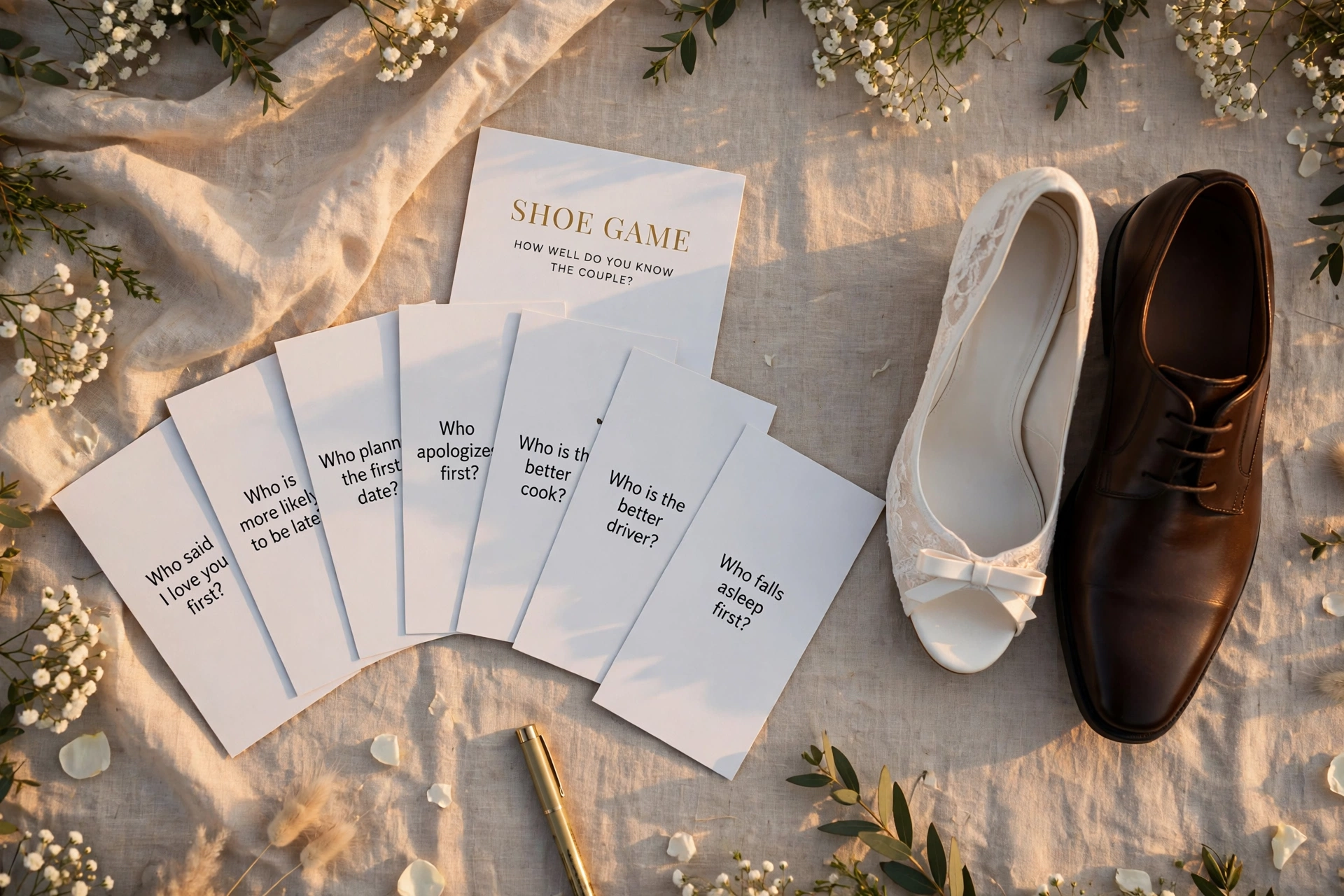
The wedding shoe game is a game for two players, usually the newly married couple, who sit back to back in the middle of the room. Each player takes off one shoe and holds it in one hand, and holds their partner's shoe in the other hand. The host reads a question out loud — "Who takes longer to get ready?" — and each player raises the shoe of the person they think the question describes. Nobody speaks. The answers are the shoes.
The fun is in the mismatches. When both players raise the same shoe, the room laughs and moves on. When they raise different shoes, the room laughs louder. Nobody is keeping score, and that is the point. It is a game about how well two people know each other, played in front of the people who know them best.
It works because it is fast. One question takes about a minute, laughs included: read it, wait for the shoes, let the laugh land, move on. Fifteen questions take about fifteen minutes. Any longer than that and the room starts to drift, however good the questions are.
A word on the name. Guests search for it as the shoe game, the wedding shoe game, and fun shoe game questions, and all three mean the same thing. This page uses "fun shoe game questions" because that is what people type, but the game itself is the same one your friends played at their wedding.
What do you need to play the shoe game?
You need less than you think. Two chairs, placed back to back in the middle of the dance floor or in a clear space where everyone can see. One shoe from each player — and it helps if the shoes look different, so the room can tell them apart at a glance. A white bridal shoe and a dark groom's shoe are easy to read from the back of the room. Two identical black shoes are not.
You need a printed question sheet for the host, with the questions numbered and the ones you plan to skip already crossed out. Do not read from a phone. A phone screen goes dark, a notification pops up, and the host loses the room while they swipe. Paper does not do any of that.
You need a microphone if the room holds more than about 40 guests. Without one, only the front tables hear the questions, and the back tables start their own conversations. With one, the whole room plays along. If there is a DJ, ask them to host it or to hold a spare microphone for the host. Most DJs have done this game a dozen times and know the pace.
You do not need prizes, a scoreboard, or a sign-up sheet. You do not need the couple to rehearse anything. The only preparation is picking your questions the night before and crossing out the ones that do not fit this couple. A question about who spends more time on their phone is funny for one couple and sore for another. You know which is which. Trust that.
How do you run the shoe game in 15 minutes?
Here is the whole plan, minute by minute. Print it with the questions and hand it to the host.
Minute 0 to 2 — Set the chairs and sit the couple down. The host explains the game in two sentences: "You each hold one of your shoes and one of your partner's. When I ask a question, raise the shoe of the person it fits." No long rules. The room learns by watching the first question.
Minute 2 to 4 — Ask three quick and easy questions. These are the warm-up. Pick simple ones — who takes longer to get ready, who is the better cook — so the couple relaxes and the room learns the rhythm. Do not start with the funniest question. Save it.
Minute 4 to 8 — Ask five questions from the romantic and funny groups. This is the heart of the game. Mix a sweet one with a funny one. A sweet question after a funny one lands better than two funny ones in a row, because the room needs a breath between laughs.
Minute 8 to 12 — Ask five questions for the wedding party and family. Bring the room in. A question about who has known the bride longer gets the bridesmaids shouting. A question about who traveled the farthest gets the far-flung relatives cheering. The game stops being about the couple and starts being about everyone in the room.
Minute 12 to 14 — Ask the last two questions, then stop. End on a high note, not on a tired one. The best last question is a kind one — who is more excited about growing old together, or who gives the better hugs. Let the room applaud, and let the couple stand up while people are still laughing.
Minute 14 to 15 — Thank the couple and hand back to the DJ. No speech, no summary, no "wasn't that fun?" The game ends when it ends. The dancing starts, and the night moves on.
Why fifteen minutes and not thirty? Because the average wedding is a big room. According to The Knot Real Weddings Study, the average 2025 wedding had 117 guests. A game that runs long in front of a hundred people feels much longer than it does in front of thirty. Fifteen minutes keeps every table in the game. The same study puts the average 2025 wedding at $34,000 (median $24,000), about $292 per guest, from 10,474 US couples married in 2025 — and this game costs nothing, which is part of why hosts love it. The study page was updated 24 February 2026, and we checked it live on 13 November 2026.
Quick and easy questions
Start here. These ten are the warm-up: simple, kind, and impossible to get wrong. Use three or four of them at the start of the game, and keep the rest as spares.
1. Who takes longer to get ready? 2. Who is the better cook? 3. Who is the better driver? 4. Who falls asleep first? 5. Who is more likely to be late? 6. Who said "I love you" first? 7. Who planned the first date? 8. Who apologizes first? 9. Who is the messier one? 10. Who spends more time on their phone?
A note on question 6. "Who said I love you first?" is the most asked shoe game question there is, and it works every time — but only if the couple is comfortable with it. If they are private people, swap it for question 8. The host should know before the game which questions are safe, and the couple should have seen the list. Surprises are for birthdays, not for weddings.
Romantic and sweet questions
These ten are for the middle of the game, when the room has warmed up. They are the questions guests remember afterwards, because they say something true about the couple.
11. Who cried first at the wedding? 12. Who is more romantic? 13. Who gives the better hugs? 14. Who remembers anniversaries? 15. Who is more likely to bring breakfast in bed? 16. Who writes the sweeter notes? 17. Who is more excited about growing old together? 18. Who fell in love first? 19. Who is the better listener? 20. Who plans the best surprises?
Question 17 is a strong closing question for this page. It is kind, it is true for almost every couple, and it lets the game end on warmth instead of a joke. If you only remember one question from this list, remember that one for the end.
Funny and playful questions
These ten get the biggest laughs, and they need the most care. Every one of them is family-friendly — nothing here would embarrass a grandparent — but the host still needs to know the couple. A joke about snoring is only funny if the couple laughs about it at home.
21. Who steals the blankets? 22. Who is more likely to fall asleep on the couch? 23. Who is the bigger snorer? 24. Who takes the longest showers? 25. Who is more likely to lose their keys? 26. Who is the better dancer? 27. Who tells the worse jokes? 28. Who is more likely to burn dinner? 29. Who hogs the remote? 30. Who is more dramatic about being sick?
If a question makes the host hesitate, cut it. There are fifty questions on this page and you only need fifteen. A cut question costs nothing. A question that lands badly costs the mood of the room, and the host cannot buy it back.
Questions for the wedding party
These ten bring the bridesmaids, groomsmen and best friends into the game. They work best in the second half, once the room is loud.
31. Who knew the couple first? 32. Who has known the bride longer? 33. Who has known the groom longer? 34. Who is most likely to cry during the speeches? 35. Who is the best dancer in the wedding party? 36. Who planned the best bachelor or bachelorette party? 37. Who is most likely to lose the rings? 38. Who gives the best wedding advice? 39. Who is the couple's go-to for help? 40. Who will the couple call first in a crisis?
Questions 32 and 33 are a pair — ask them together and let the two sides of the room argue it out for a moment. It is one of the few times in the game when the guests get to answer, and they love it. Keep it short, though. One minute of shouting is fun. Three minutes is a different game.
Questions for family and older guests
These ten are for the parents, grandparents, aunts and uncles — and for the guests who traveled furthest to be there. They keep the older tables in the game instead of watching it from the side.
41. Who gives the best advice in the family? 42. Who is the best cook in the family? 43. Who tells the best family stories? 44. Who is most likely to embarrass the couple with an old photo? 45. Who traveled the farthest to be here today? 46. Who has been married the longest? 47. Who is the best dancer among the parents? 48. Who is most likely to host the next family dinner? 49. Who is most likely to start the dancing? 50. Who taught the couple the most about love?
Question 50 is a good question to ask near the end, right before the closing question. It turns the room's attention to the parents for a moment, and it usually gets the warmest reaction of the night. If the couple's parents are not there, swap it for question 45. For a December wedding, the family table will also enjoy our free printable Christmas games and the bingo game for Christmas — the same print-at-home idea, tuned for the season.
How do you pick the right 15 questions for your couple?
Fifty questions is a menu, not a script. You need fifteen, and the right fifteen depend on the couple. Here is how to choose them in ten minutes the night before.
First, take three from the quick and easy group and five from the romantic and funny groups. That is your core eight. Then take five from the wedding party and family groups. That is thirteen. Finish with two kind questions for the close — a sweet one, or one about the family. That is fifteen, and it covers the whole room.
Second, read each one out loud and ask: would this couple laugh? If you hesitate for even a second, cross it out and take the next one from the same group. There is no shortage of questions on this page. The only shortage is time in the game, so spend it on the sure things.
Third, check the balance. If all fifteen are jokes, the game feels like a roast. If all fifteen are sweet, it feels like a toast. The mix that works is about half funny, half sweet, with one or two questions that bring in the family. The run sheet above already does this for you — quick questions first, romantic and funny in the middle, family at the end.
Fourth, show the list to the couple. Not for approval of every question — they will overthink it — but for one veto each. Give each of them one veto. If either of them says no to a question, it is out, no discussion. That one rule prevents every awkward moment this game has ever caused.
If you want a second game for the same crowd, the same choosing method works for our he said she said bridal shower game, which has 30 questions in five groups and a timed host plan for 25 guests. It is a different game — a question card, not the shoe game — but it is built the same way, and it is the natural next game for a shower or a rehearsal dinner. And if the couple's friends are planning a shower next, our printable baby shower games page has 12 games in the same print-and-play format.
What mistakes spoil the shoe game?
Most shoe games go wrong in the same few ways, and all of them are avoidable.
The first mistake is asking too many questions. Twenty-five questions feels generous on paper and endless in a room. The game has one job — fifteen minutes of laughter — and every question after the twentieth works against it. Pick fifteen. Stop at fifteen.
The second mistake is starting with the hardest question. A host who opens with the funniest, sharpest question has nowhere to go. The room laughs, and then the next four questions feel flat by comparison. Start easy. Build. Save the best for the middle.
The third mistake is a question nobody can hear. The host reads from a phone, the microphone is off, the back tables cannot hear the question, and they stop playing. Test the microphone before the couple sits down. Read the first question out loud to the back of the room and ask if they can hear it. Thirty seconds of checking saves fifteen minutes of mumbling.
The fourth mistake is an embarrassing question. The shoe game is not a roast. A question about an ex, about money, about something the couple fought over — none of that belongs in front of the whole room. The test is simple: would you ask it with both sets of parents in the front row? If not, it does not go on the list. The couple's veto rule above exists for exactly this reason.
The fifth mistake is playing it at the wrong moment. The shoe game belongs between dinner and dancing, when everyone is seated and happy. Played during dinner, it interrupts the meal. Played after dancing has started, it stops the party to drag people back to their chairs. If the evening is running late, cut it to ten questions rather than skipping it — a short game at the right time beats a long game at the wrong one.
The sixth mistake is forgetting the shy couple. Not every couple wants to be the center of attention for fifteen minutes. If the couple would rather not play, do not make them. Offer the game to the wedding party instead — two bridesmaids back to back, answering questions about the bride — or skip it and let the dancing start. A game nobody wants to play is not a game. It is a chore with an audience.
How should you print the question sheet?
Print one copy for the host and one spare. Print at actual size on plain white paper, in black ink, with the questions numbered. Large type matters — the host is reading in a dim room, often without their glasses. If your printer has a large-print or 14-point option, use it.
Print the run sheet on the same page as the questions, or on the back. The host should not have to flip between two sheets while the room is waiting. One sheet, everything on it: the fifteen questions in order, the timing, and the closing line.
Cut the questions you are not using before you print. Do not print all fifty and cross out thirty-five in pen — the host will lose their place. Print the fifteen you chose, in the order you will ask them. If you want spares, print five more on a second sheet, marked "spares," and keep it under the first sheet.
If the couple wants a keepsake, print a second copy for them after the game, with the questions they answered and a line at the bottom for the date and the venue. It costs one sheet of paper and it is the kind of thing that ends up in a memory box. For the rest of the wedding paper — the checklists, the run sheet, the games — the wedding planning checklist printable carries the same print-at-home idea through the whole day. The same one-sheet setup works for a child's party too — our free printable birthday games for kids use it for eight party games.
Where should you go next?
You have the questions, the host plan, and the printing tips. The next step is the day itself, and the page that holds it together is the coordinator checklist. Our free printable wedding coordinator checklist has the full hour-by-hour run sheet for a 4 pm ceremony, a vendor contact sheet, and an emergency kit list — the shoe game sits in it as one fifteen-minute slot among all the others. Print it, hand it to your coordinator, and the game will happen on time, in the right gap, with the right questions.
Try it on MerryHub
- Browse all wedding printables
- He said she said bridal shower game
- Free printable wedding coordinator checklist