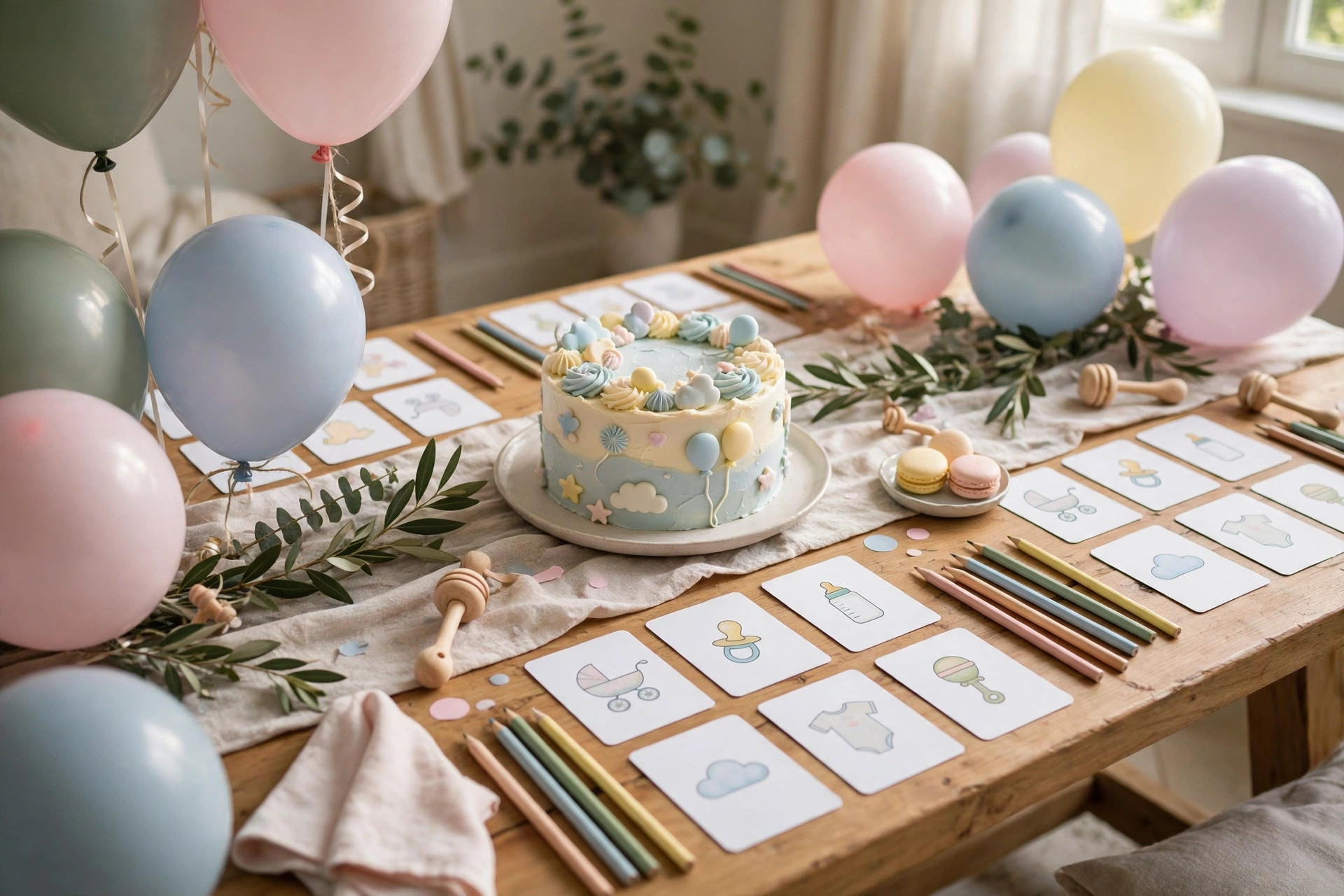
Quick answer: Printable baby shower games are ready-made game sheets you print at home and hand out at a shower, so guests can play without you making up rules on the spot. This guide gives you 12 games that work for mixed groups, with clear rules, timing, and a 45-minute plan.
What makes a baby shower game work?
Printable baby shower games are sheets you print at home, hand out at the party, and play with very little setup. Guests get a sheet, a pen, and a clear job to do. You get a room full of people talking, laughing, and actually meeting each other, instead of sitting in small quiet groups waiting for cake.
That matters more than most hosts expect. A shower brings together people who may not know each other at all. Work friends sit next to cousins, neighbours next to college friends. A good game gives them a reason to talk beyond small talk, gives shy guests something to do with their hands, and gives loud guests a friendly way to shine without taking over.
If you are planning other party printables too, start with the full set on printables. For a younger crowd, the ideas in Free Printable Birthday Games for Kids show how the same print-and-play idea works when the players are children. And once the baby arrives, a simple note means a lot, which is why many hosts also keep the card maker in mind for later.
A game works when everyone can join in without feeling put on the spot. That is the whole test. If a game needs someone to stand up and perform, sing alone, or share a private story in front of strangers, a lot of guests will quietly hate it, even if they smile. If a game lets people play from their seat, write an answer down, or work in a small team, almost everyone will join.
Keep the rules short. One minute to explain is plenty. If you need five minutes to explain a game, it is too fiddly for a party. Guests should hear the rule once and start playing. Five to eight minutes per round feels brisk and keeps energy up.
Mix the types. A word game, a guessing game, and a listening game feel different from each other. Three word games in a row feel like a test, and three guessing games feel repetitive. The list below mixes them on purpose.
Skip games that single people out, like guessing the size of the mum-to-be, wearing something silly all afternoon, or answering personal questions about family. Guests relax when they know they will not be made the joke, and the party is livelier for it.
What do you need before the party?
You need less than you think. Printed sheets, one per guest, plus a few spares. Pens that actually work. A timer on your phone. Small prizes, one per game. A flat surface for writing, even if that is just a book on a lap. That is it.
Print one copy first and play it yourself. Check the words are large enough to read, there is space to write answers, and nothing is cut off at the edge.
Print a few extra sheets for spills, lost pens, and late guests. Keep the answer list with you, not on the table, so nobody peeks early.
Game 1: Baby Bingo
Baby Bingo is the classic for a reason. It works while gifts are being opened, it works for guests who arrive late, and it needs almost no explaining.
How to play:
Give this game about 15 minutes if you play it during gift opening, or about 8 minutes as a stand-alone round with a list of words you read out. The host script is simple. Say: "Here is your card. When you hear one of these words, cross it off. First full line wins. No shouting until you have the whole line, please, or we will have three false alarms."
This game suits quiet guests, who can play without talking, and chatty guests, who still talk between gifts. It also fills the gift-opening lull, when attention can drift.
- Give each guest a bingo card with baby words on it, like bottle, blanket, nappy, and teddy.
- As gifts are opened, guests cross off each word they hear or see.
- The first guest to get a full line calls out bingo.
- Check the card against the gifts, then hand over a small prize.
Game 2: Baby Word Scramble
Word scramble is a calm, seated game that wakes brains up without pressure. Guests unscramble baby words and write the answers on their sheets.
How to play:
Try words at mixed difficulty. Some easy, like yabb for baby, some harder, like ttelob for bottle. All hard and guests give up. All easy and fast finishers get bored.
Host tip: allow pairs for this one. Two guests who have never met will start talking about the words, and that chat often lasts after the game ends.
- Hand out a sheet with 12 to 15 mixed-up baby words.
- Guests work alone or in pairs for five minutes.
- The guest with the most correct answers wins.
- Read the answers out slowly so guests can mark their own sheets.
Game 3: Guess the Baby Food
This is a tasting game without any mess, if you run it as a guessing sheet rather than a real tasting table. Guests match baby food flavours to their descriptions, or guess from a list.
How to play:
Keep the tone light. This game is funny because adults are guessing baby food, not because anyone gets it wrong. Read the answers with a smile, not as a test result.
- Print a list of baby food flavours with the labels hidden.
- Guests write down what they think each flavour is.
- Give guests five minutes to finish the list.
- Reveal the answers one by one, with a short pause for groans and laughs.
Game 4: Baby Shower Trivia About the Mum-to-Be
Trivia about the mum-to-be feels personal, but only if the questions are kind and easy. Ask about favourite foods, first jobs, or happy memories, not about private or awkward topics.
How to play:
The host script matters here. Say: "No trick questions, I promise. These are all things you could guess or know from a good chat. If you do not know, guess. A funny guess counts as a good answer in this room." That one line lowers the pressure a lot.
Check every question with the mum-to-be first and remove anything she would not want read out loud. If she laughs when she reads the list, you have the right questions.
- Print 10 questions about the mum-to-be, with space for answers.
- Guests answer alone in about six minutes.
- The mum-to-be reads the answers out, or the host reads them with her permission.
- Most correct answers wins, and ties share the prize.
Game 5: Do Not Say Baby
This is a running game that lasts the whole party, not just one round. Guests wear a small token, like a peg or a ribbon, and try not to say the word baby.
How to play:
Explain it at the start, in under a minute. Say: "You each get a peg. If you catch someone saying the word baby, you take their peg. Try to finish with the most pegs. Be kind about it. A quiet tap and a smile is enough."
This game keeps working in the background while people eat and chat, gives strangers a gentle excuse to talk, and gives the host a break once it starts.
- Give each guest a peg or token when they arrive.
- If someone hears another guest say the word baby, they can take that guest's peg.
- Guests who lose their peg can try to win one back by catching someone else.
- At the end, the guest with the most pegs wins.
Game 6: Baby Emoji Pictionary
Emoji games work well because they need no special knowledge. Guests decode a line of emojis into a baby phrase or song title.
How to play:
Use phrases guests will know, like a bottle, a lullaby, or a first step. Avoid obscure phrases that only one guest would know. The fun is in the shared "oh, of course" moment when the answer is revealed, not in a puzzle nobody can solve.
Pairs work well here. One guest sees the bottle, the other sees the song, and together they get further than either would alone.
- Print 10 emoji puzzles on one sheet.
- Guests work alone or in pairs for six minutes.
- Read the answers out and let guests mark their own sheets.
- Most correct answers wins.
Where did baby showers come from?
Baby showers as we know them today grew out of older customs where friends and family gathered to welcome a new baby and help new parents prepare. The modern party, with games, gifts, and a guest of honour, took shape in the United States in the twentieth century and spread from there. If you want the fuller history, read where baby showers come from for the background on how these gatherings changed over time.
That history explains why games feel natural at a shower. The party was never just about gifts. It was about a group saying, together, that a new baby matters and that new parents will not do this alone.
You do not need to turn this into a history lesson at the party. Just know that the games are doing old work in a new form. They bring people together around a shared happy event, which is what showers have always done.
Game 7: The Price Is Right, Baby Edition
This game asks guests to guess the price of everyday baby items, without anyone needing to shop first. Use a printed list, not real products, to keep it simple.
How to play:
Do not make this a test of shopping knowledge. New parents, grandparents, and friends without children will guess very differently, and that spread is what makes it fun. Read the answers with surprise, not judgement.
Keep the items everyday and familiar, like bottles, blankets, and nappies. Rare items are not fair, because most guests will have no starting point.
- Print a list of 10 everyday baby items, with no prices shown.
- Guests write down their best guess for each item.
- The host reads the real prices from an answer sheet.
- Closest guesses win, and you can award a point per close answer or one prize for the best overall list.
Game 8: Baby Shower Bingo, Gift Version
This is a second bingo idea for hosts who want bingo twice without repeating the same card. In this version, guests fill in their own bingo squares before gifts start.
How to play:
This version takes about five minutes to set up and then runs itself during gift opening, while guests compare guesses about what the mum-to-be will get most of.
If you already played Game 1, pick one bingo game only, or spread the two versions out. Two bingo games back to back feel repetitive.
- Give each guest a blank bingo grid.
- Guests fill each square with a gift they expect to see, like a blanket or a toy.
- As gifts are opened, guests cross off matches.
- First full line wins.
Game 9: Wishes for Baby
Wishes for Baby is not a competitive game, and that is why many guests love it most. Guests write a short wish, note, or piece of advice for the baby, and the mum-to-be keeps the cards.
How to play:
Give guests a starter line if they freeze, like "I hope you always..." A starter helps guests who say they are bad at writing. Most write something lovely once they start.
This is also a natural moment to think ahead. Guests often ask what to write in a card once the baby is here, for birthdays and milestones later on. For that next question, what to write in a birthday card gives simple wording ideas that work when you sit down to write and the page feels blank. Keep the wishes cards simple. Short and honest beats long and fancy.
- Give each guest a small card and a pen.
- Ask guests to write one wish for the baby, in one or two sentences.
- Collect the cards in a box or book.
- Read a few out loud only if the mum-to-be wants you to, and keep the rest private for later.
Game 10: Baby Animal Match
Baby animal names are a gentle trivia game that works for all ages. Guests match adult animals to their baby names, like a cow and a calf.
How to play:
This game is calm and inclusive. Guests who know little about babies still know animals, and children at the shower can often join too.
Add a few easy matches and a few harder ones, so early wins keep guests going and keen players still have something to work on.
- Print a list of adult animals on one side and baby names on the other, mixed up.
- Guests draw lines to match them in about five minutes.
- Read the answers out slowly.
- Most correct matches wins.
Game 11: Baby Shower Scavenger Hunt, Seated Version
A scavenger hunt sounds active, but the seated version works better at a shower. Guests search their bags and pockets for items on a list, and show them without standing up.
How to play:
Keep the list everyday and kind. Avoid items that single out guests, like a wedding ring, because not everyone will have one and the game can feel uneven.
Set a clear end time. Say: "Five minutes, starting now. Show what you have, no running to the car."
- Print a list of everyday items, like a red pen, a photo, or a hair tie.
- Guests check their bags and pockets for each item.
- Guests score a point for each item they can show.
- Most points after five minutes wins.
Game 12: Left Right Gift Game
The Left Right game is a story game for the end of the party. Guests pass a small gift left or right every time they hear those words in a short story.
How to play:
Keep the story short, about two minutes to read, about the baby, a first day at home, or a trip to the park. Read slowly and pause after each direction word, so guests can pass the gift without panic.
This is a good closing game because everyone plays at once and the ending feels random and fair. Nobody has to answer a question or perform.
- Seat guests in a circle, or in a rough circle if chairs allow.
- Give one small wrapped gift to a guest to start.
- Read a short story that uses the words left and right many times.
- Every time guests hear left, they pass the gift left. Every time they hear right, they pass it right.
- Whoever holds the gift at the end of the story keeps it.
A real party plan: one host, mixed guests, 45 minutes
Picture this. Sara is hosting for her friend Aisha. The guests are a mix of Aisha's work friends and her family. Most of them have never met. Sara wants games, but she does not want anyone embarrassed, and she does not want the party to feel like a school lesson.
Sara picks four games, not twelve. The twelve games in this guide are a menu, not a schedule. You pick the ones that fit your group and time.
Here is the 45-minute running order Sara uses, and you can use it without buying anything:
Notice what Sara leaves out. No guessing games about bodies, no dares, no songs sung alone, no personal questions. The party still feels lively, and the mixed group leaves knowing each other a little better.
If your party is longer, add one more game, not three. If it is shorter, pick two games and the wishes cards. A short party with two good games beats a long party with six rushed games.
- Minutes 1 to 5: Welcome and Do Not Say Baby. Hand out pegs at the door. Explain the rule in under a minute. Guests start chatting with a game already running.
- Minutes 6 to 13: Baby Word Scramble in pairs. Pairs mix work friends with family on purpose, by seating or by simply asking guests to pair with someone they have not met yet.
- Minutes 14 to 21: Baby Shower Trivia About the Mum-to-Be. Aisha reads the answers, with Sara helping. Questions are kind, easy, and checked with Aisha first.
- Minutes 22 to 37: Baby Bingo during gift opening. Guests play while gifts are opened, so the gift part feels shared, not watched.
- Minutes 38 to 45: Wishes for Baby. Guests write one short wish each. Sara collects the cards. Aisha reads two or three out loud, only the ones she likes, and keeps the rest.
Why one small prize per game beats one big prize
Here is a view I hold firmly for showers, and it comes from watching rooms, not from a rule book. One small prize per game beats one big prize at the end, every time.
A big prize at the end makes early games feel like qualifiers. Guests who lose first feel out of the running, and the room splits into winners and watchers.
Small prizes keep every game fresh. A guest who lost the word scramble can still win bingo, and a guest who knows nothing about baby food can still win the animal match. Each game is a new start.
Small does not mean thoughtless. A candle, a small plant, a notebook, or a box of tea all work. Wrap them simply and hand the prize over with the winner's name and a short thank you.
Printing tips that save you stress
Print in black and white if colour printing is costly or slow. Most sheets read clearly in black and white, as long as the words are large. Colour is nice, but not needed.
Use plain paper, not thick card, for sheets guests will write on. Pens skip on card, while plain paper is easier to write on and stack.
Print one test sheet and check it in daylight. A sheet that looks fine on a laptop can look tiny on paper. If you squint to read it, guests will too.
Keep pens simple. Ballpoint pens work well on plain paper. Put two pens per table, or one per guest if you have enough, because a guest without a pen cannot play.
What to do after the games are explained
Once you have picked your games, you do not need a full party kit to run them well. The sheets in this guide, the running order above, and the host scripts for bingo, trivia, and Do Not Say Baby are enough for a warm, lively shower on your own.
If you want the work done for you, with matching sheets that all look like they belong together, the next step is simple. The Baby Shower Bundle on printables costs $4 and includes 10 games, bingo cards, tags and a banner. That set covers the main games in one matching pack, so you print once and you are ready, with tags and a banner for the table as well.
MerryHub makes printable games, cards and planners for parties and family events that families download and print at home.
Your next step: the Baby Shower Bundle
Do not end your planning with a long list and no decision. Pick your games, pick your running order, and get the sheets ready. If you want one matching set to print and use, go to the Baby Shower Bundle on printables. It costs $4 and includes 10 games, bingo cards, tags and a banner, so you can print your games, tags, and banner from one set and focus on hosting, not hunting for sheets.
Start with the 45-minute plan above, add the wishes cards at the end, and keep one small prize per game.
The he said she said bridal shower game is the crowd favourite for showers — 30 ready questions, a printable card and a timed host plan.
For the wedding itself, the same idea becomes our fun shoe game questions — 50 questions in five groups with a 15-minute host plan for the reception version.