Quick answer: A Christmas countdown plan gives children one small activity for each day from 1 to 24 December, instead of a chocolate or a toy. The plan below has 24 no-candy, no-buy activities for ages four to ten, using things already at home. Pick one per day, swap it on busy days, and skip a day without guilt.
Why a no-candy, no-buy countdown works
December already brings plenty of sweets and plenty of presents. A countdown built on activities instead gives children something different: something to do together, every day, that costs nothing and leaves a memory. Children do not remember the chocolate from the seventh of December. They remember the night they built a blanket fort and read stories inside it by torchlight.
An activity countdown also solves the fairness problem. Chocolate calendars end in arguments about who got the best piece, and toy calendars end in a pile of plastic by the second week. An activity ends in a shared moment, and shared moments do not cause arguments. Parents also feel better about it, because the countdown adds calm to December instead of adding sugar and clutter.
The plan below is built for real families. Every activity takes fifteen minutes or less, uses things you already own, and works after school or after work. Nothing needs a shop trip. Nothing needs preparation the night before, except reading the next day's activity so you know what is coming.
If you are still choosing how to present each day, our Printable Advent Calendar Activity Cards for Kids guide walks through pockets, jars and envelopes in detail, and the ready-made sets sit together in the printables collection.
Three ways to run the countdown
Pick the method that fits your family. The activities stay the same, only the reveal changes.
If you would rather not write the cards yourself, the ready-printed set of Advent Activity Cards on the printables page gives you 25 printed cards in a matching design, and you can use the on-site countdown tool to watch the days tick down together. The plan below works with either route, or with handwritten cards, exactly the same.
- Activity cards. Write each day's activity on a small card, fold it, and put the cards in a jar, a box, or a row of envelopes. Each morning, a child draws the day's card. This is the most exciting method, because the activity is a surprise. It is also the easiest to run, because the cards are made once, before December starts.
- A jar of folded slips. Write each activity on a slip of paper and fold it into a jar. Each morning, a child pulls one slip. This is the simplest version of the card method, and it works well for younger children who love the lucky-dip feeling.
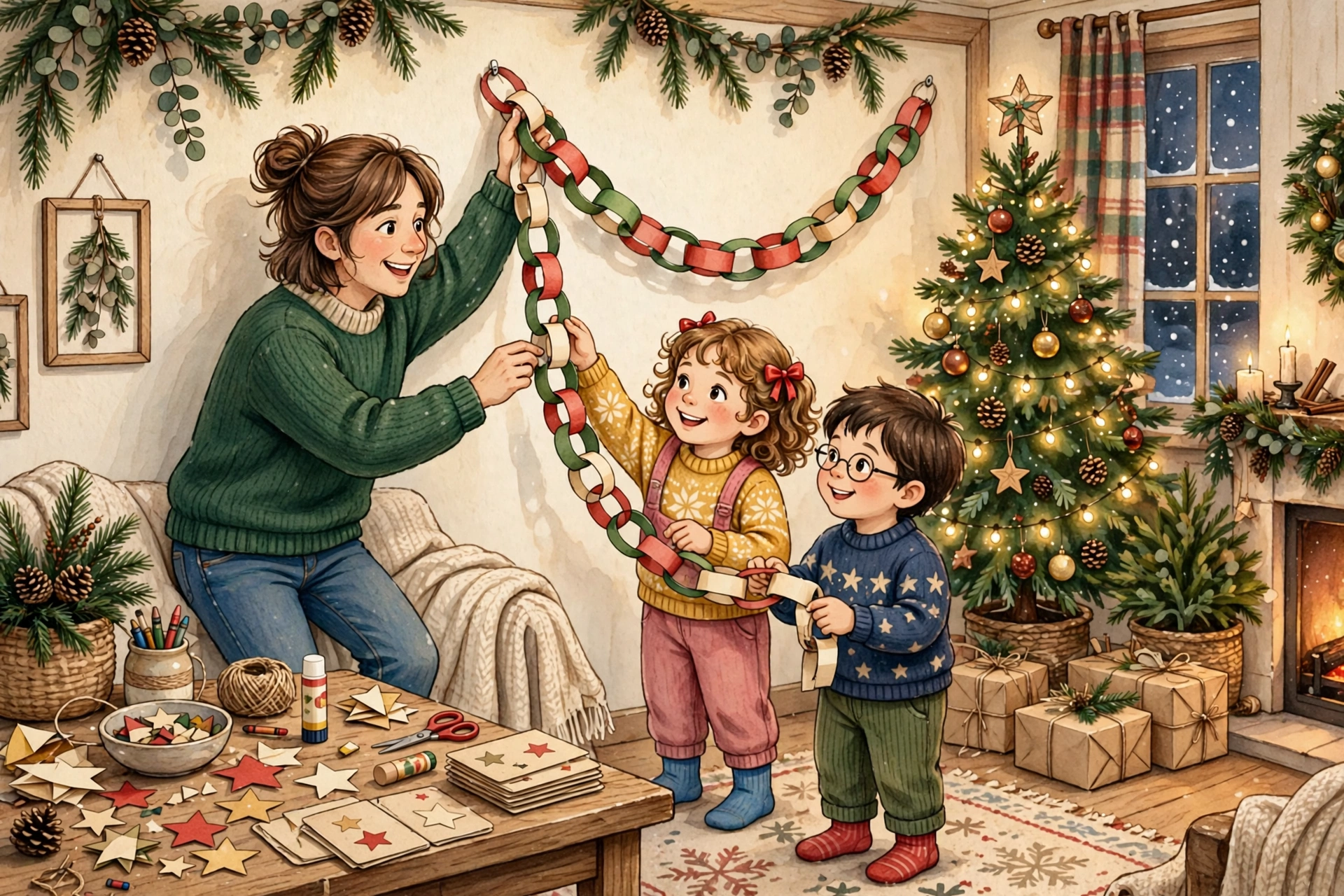
- A paper chain. Make a chain of 24 paper loops, one for each day, and write one activity inside each loop. Each evening, tear off a loop and read tomorrow's activity together. This method doubles as a decoration, and children love watching the chain get shorter as Christmas gets closer.
Days 1 to 6: getting ready and getting cosy
The first week is about settling into December. Keep the activities gentle and cosy, because the excitement is already high and children do not need more stimulation. They need warmth.
- Day 1: Decorate a countdown corner. Pick a shelf or a corner of a room and decorate it together with paper chains, drawings, and anything Christmassy you already own. This corner becomes the home of the countdown.
- Day 2: Write a letter to Santa. Sit down together and write it properly, with a beginning, a middle, and a thank you at the end. Post it, or leave it by the fireplace, or tuck it into a book for safekeeping.
- Day 3: Make paper snowflakes. Fold paper, cut shapes, and open them up to see the surprise pattern. Stick them on windows. No two are alike, which is the whole point.
- Day 4: Hot chocolate story time. Make hot chocolate, or warm milk, and read one Christmas story together, slowly, with no screens on. Let children pick the story.
- Day 5: Build a blanket fort. Push chairs together, drape blankets over them, and sit inside with torches and books. Eat a snack inside the fort, because snacks taste better in forts.
- Day 6: Draw your dream Christmas tree. Give each child paper and crayons and ask them to draw the wildest Christmas tree they can imagine. A tree made of sweets, a tree that touches the moon, a tree with a slide. Display the drawings.
Days 7 to 12: making, giving and helping
The second week turns outward. Children make things, give things, and help around the house. This is the week that teaches the part of Christmas that is not about receiving.
- Day 7: Make a card for someone you love. One card, made by hand, for a grandparent, a teacher, or a neighbour. Write a real message inside, not just a name. Post it or deliver it by hand.
- Day 8: Bake something simple together. Biscuits, a cake from a packet mix, or toast with toppings arranged into a face. Let children stir, pour, and taste. Mess is part of it.
- Day 9: Tidy one drawer or shelf together. Pick one small space, empty it, keep what matters, and put it back neatly. Children who help tidy feel proud of a home that looks cared for.
- Day 10: Learn a Christmas song. Pick one song the whole family can sing, learn the words together, and sing it at least twice. Badly is fine. Loudly is better.
- Day 11: Make a bird feeder. Smear peanut butter on a pine cone or a toilet roll tube, roll it in seeds, and hang it outside. Watch for birds the next morning.
- Day 12: Wrap a present for someone else. Let children wrap a gift for a family member, even if the wrapping is wonky. Wonky wrapping is the best kind, because it shows a child did it.
Days 13 to 18: games, stories and quiet magic
The third week is the busiest part of December, with school events, shopping, and visitors. These activities are calm on purpose. They give children a quiet pocket in a loud week.
- Day 13: Christmas bingo. Draw a simple bingo grid with Christmas pictures: a tree, a star, a snowman, a robin, a present. Call out the pictures and mark them off. The winner picks tomorrow's bedtime story.
- Day 14: Shadow puppets by torchlight. Turn the lights off, switch on a torch, and make animal shapes with your hands on the wall. Let children invent a story to go with the shadows.
- Day 15: Read a Christmas poem aloud. Pick a short poem, read it slowly, and talk about which line each person liked best. Children who hear poetry read aloud learn to love words.
- Day 16: Make a paper chain garland. Cut strips of coloured paper, loop them together, and hang the chain across a doorway. Count the loops together and talk about how many days are left.
- Day 17: Indoor picnic. Spread a blanket on the living room floor, eat dinner or a snack on it, and pretend you are camping in the snow. Children love a picnic that breaks the normal rules.
- Day 18: Tell a made-up Christmas story. Take turns adding one sentence each to a story about a snowman, a reindeer, or an elf who lost something. Write the best lines down if you want to keep them.
Days 19 to 24: the final countdown
The last week is pure excitement. These activities lean into it, while keeping children busy on the days when waiting feels hardest.
- Day 19: Decorate cookies or plain biscuits. Use icing, sprinkles, or anything in the cupboard. Let children design their own biscuit and eat it straight away.
- Day 20: Make reindeer food. Mix oats with a little glitter, put it in a small bag or envelope, and label it for Christmas Eve. This is a tradition children remember for years.
- Day 21: Christmas movie night. Pick one family Christmas film, make popcorn, and watch it together with blankets and the lights low. No phones during the film.
- Day 22: Act out the nativity or a Christmas tale. Use dressing-up clothes, towels, and tea towels. Let children choose their roles. Keep it short and silly rather than perfect.
- Day 23: Prepare the Christmas Eve plate. Put out a plate, a glass, and a small note for Santa together. Talk about what to leave and why, and let children write the note themselves.
- Day 24: Read one final story and hang the stockings. End the countdown the way it started: together, calmly, with a story. Hang the stockings, say goodnight, and let the excitement do the rest.
The busy-day easy-swap rule
Some days will be too busy for the planned activity. That is normal, and the plan expects it. The rule is simple: on a busy day, swap in one of these three easy activities, and move the planned activity to another day or drop it entirely.
Keep this rule somewhere visible, on the fridge or inside the jar lid, so that on a hard evening you do not have to think. You just swap, and the countdown keeps going. A swapped day is still a countdown day.
- Easy swap one: draw a Christmas picture. Paper and crayons, ten minutes, done.
- Easy swap two: sing one Christmas song together. One song, all together, in the kitchen or the car.
- Easy swap three: read one page of a Christmas book. One page is enough. The ritual matters more than the length.
The missed-day rule: skip or double up, no guilt
You will miss a day. Everyone does. A child gets ill, work runs late, or the day simply disappears. When that happens, you have two choices, and both are fine.
Skip the day and move on. The countdown does not need to be perfect to be wonderful. Children will not remember the missed day. They will remember the twenty-odd days that happened.
Or double up the next day, doing two short activities instead of one. This works well when the missed activity was a quick one, like drawing a picture or singing a song. Do not double up two long activities, or the day becomes a chore. One short plus one short is the limit.
What you must not do is turn a missed day into guilt or a lecture. The countdown is a gift to your family, not a test. If December gets hard, the kindest thing is to let a day go and enjoy the next one properly.
Mixed-age tips: four-year-olds and ten-year-olds together
A plan for ages four to ten has to stretch in both directions. Younger children need simple tasks and lots of praise. Older children need a real job, not a baby task. The trick is to give each child a role inside the same activity.
For craft activities, let younger children cut, stick, and colour, while older children design, measure, and help the younger ones. For cooking, let younger children stir and taste, while older children read the steps and handle the oven with an adult. For games, let younger children be on a team with an older child, so they win together.
Older children also love being in charge of something. Let the oldest child be the Keeper of the Jar, drawing the card each morning, or the Keeper of the Chain, tearing off the loop each evening. A title and a job keep older children in a game they might otherwise call babyish.
If the age gap is wide, split one activity into two versions. A four-year-old draws a snowman; a ten-year-old writes a snowman story. Same theme, different challenge, both proud at the end.
And if a toddler is watching all of this with great interest, give them a way in that cannot break anything. Tear a spare loop off the paper chain for them to scrunch, hand them a big sticker to press onto the finished craft, or make them the official counter: everyone counts the snowflakes, the loops or the baubles out loud, and the smallest voice gets to shout the last number. They will not remember the activity. They will remember being included in the noise of it.
For children who find surprises hard, not easy
Most of this plan assumes the surprise is the fun. For some children it is the opposite. A child who worries about what is coming, who asks the same question ten times, or who melts down when a plan changes may spend the morning anxious about the card instead of enjoying it. The countdown can still work beautifully for them — it just needs the unknown taken out of it, quietly, without any fuss or announcement.
Try a small preview the night before. After bedtime stories, whisper tomorrow's activity like a secret you are sharing early because they are trusted. Or offer a choice between two sealed cards each morning: they cannot see either activity, but they chose which envelope to open, and that scrap of control changes everything. Keep the time and place of the opening exactly the same every day, keep the activities gentle, and repeat one favourite every week if repetition soothes them. A countdown that feels predictable is not a failed countdown. For that child, the sameness is the gift. On a good day, one of the two choices can be a short, calm round from our Free Printable Christmas Games — offered, never sprung on them.
Making the countdown yours
The plan above is a starting point, not a law. Swap any activity that does not suit your family. If you do not celebrate with Santa, swap the Santa activities for something that fits your traditions. If your children hate crafts, swap a craft day for a game day. The best countdown is the one your family actually enjoys, not the one that looks best on paper.
Write your final list before December starts, put it in the jar or on the chain, and then relax. The planning is done. December can now be about the small daily moment: a card drawn, an activity shared, a memory made. That is the whole point of counting down.
When you are ready to set yours up, your next step is our Printable Advent Calendar Activity Cards for Kids guide: choose your pockets, jar or envelopes there first, then come back to this plan and fill them day by day.