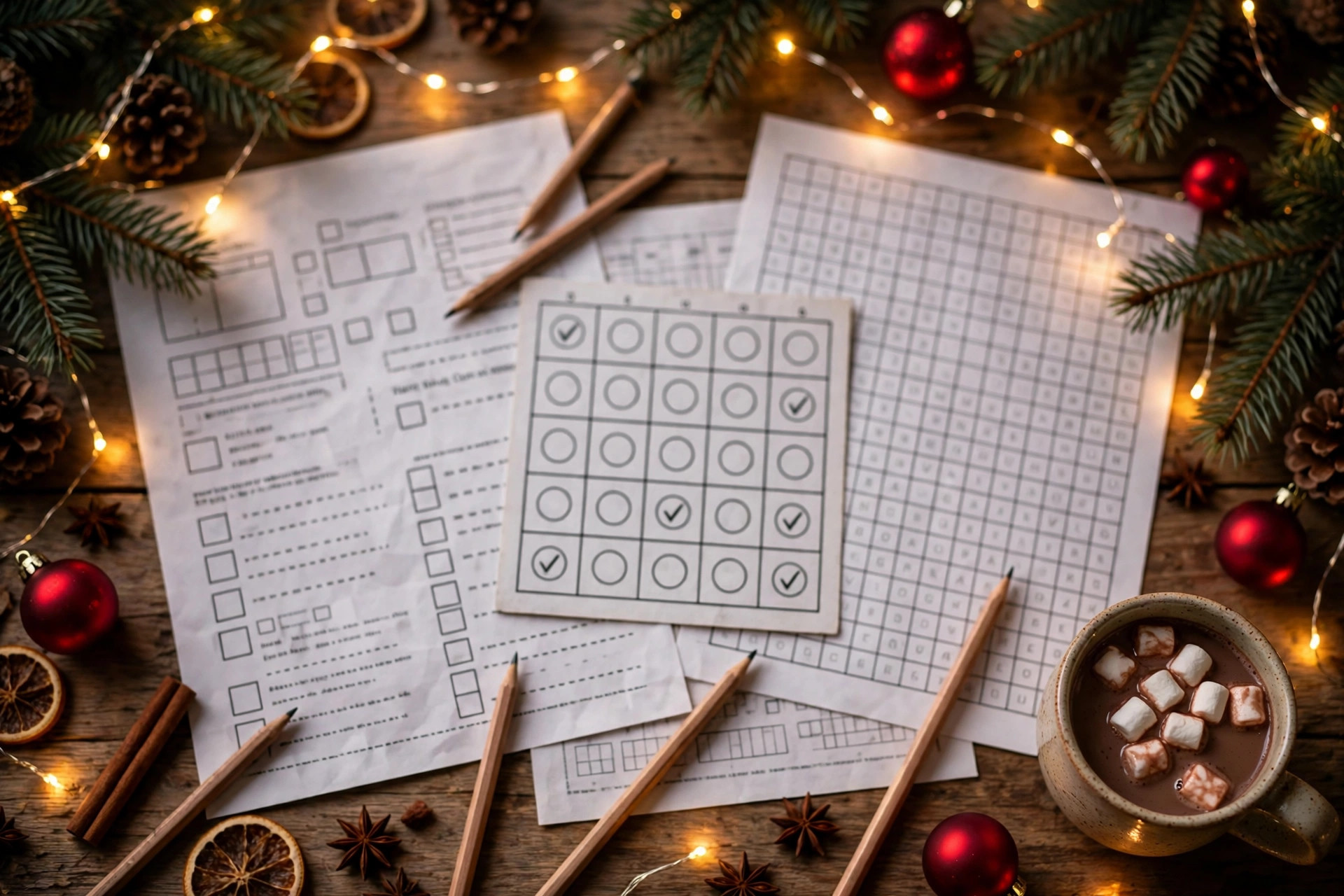
Quick answer: The best free printable Christmas games are the ones that need no setup: trivia, bingo, a word search, emoji pictionary and a word scramble cover kids, teens and adults in one print run. Print one copy per player, keep an answer key for the host, and you can start playing in under ten minutes.
Why printable games work so well at Christmas
A good Christmas game has three jobs. It must fill the quiet gap before dinner, mix guests who do not know each other, and end before anyone gets bored. Printable games do all three. There is nothing to buy, nothing to charge, and no app for grandparents to download. They also fix the age problem. A board game pitched at adults loses the kids. A kids' game loses the teenagers. A printed sheet meets each player where they are: a six-year-old can hunt words in a word search while the adults argue over trivia two seats away. Below are eleven games worth printing this year, with honest notes on who each one suits, how long it takes, and what to print.
1. Christmas trivia
Sixteen questions is the sweet spot — long enough to feel like a real contest, short enough to finish before dessert. Mix easy questions ("What colour is Rudolph's nose?") with two or three that make adults think. Read the questions aloud, let teams write answers, and swap sheets for marking so nobody grades their own paper.
Short on time? Start with the free printable Christmas quiz on MerryHub — twelve questions with a full answer key, ready to print.
Make the teams mixed-age on purpose. A team of only adults will win the film questions and lose the cartoon ones; a team with a nine-year-old and a grandparent covers both, and argues more enjoyably. Rotate who writes the answers each round so one confident voice does not take over, and award one bonus point per round for the funniest wrong answer — it keeps the losing team playing hard to the end.
- Best for: mixed ages, big groups, office parties
- Time: 15–20 minutes
- Print: one answer sheet per team, one answer key for the host
2. Christmas bingo
Bingo is the game nobody needs taught. Print a different card for each player, cut out the caller slips, fold them into a bowl, and draw one at a time. Use coins, buttons or wrapped sweets as markers. The first full line wins — then play on for the full card so the game lasts.
Two small variations stretch bingo across a whole afternoon. Swap the caller halfway through, because being the caller is half the fun for older children, and let the winner of each round choose the prize from a small pile of wrapped sweets rather than handing over one big prize at the start. For pre-readers, call the picture as well as the word — "a star, the pointy one for the top of the tree" — so nobody is quietly lost.
- Best for: kids and grandparents together, classrooms
- Time: 10–15 minutes per round
- Print: one card per player (every card must be different), one caller sheet
3. Christmas word search
A word search is your quiet game. Put a stack on the table and watch it absorb early arrivals, shy guests and kids who need a calm corner. Fifteen hidden words at a normal grid size takes most people five to ten minutes. Keep the solution sheet hidden until someone is truly stuck.
- Best for: all ages, waiting time, classrooms
- Time: 5–10 minutes
- Print: one per person, one solution for the host
4. Emoji pictionary
Each row shows a line of emojis that spell out a Christmas song, film or phrase. Players write down what they think each row means. This is the game that gets the loudest reactions, because the answers feel obvious the second someone says them out loud. Ten rounds is plenty.
Play it in pairs if the room is big. One partner may say the answer aloud only after both have written a guess, which stops the quickest shouter from ending every row in two seconds. Put a phone face-down in the middle of the table as the timer: when a gentle alarm sounds, pens down, answers read out in order. The rows nobody solved are worth reading twice — they are always the ones everyone swears were impossible.
- Best for: teens and adults, party warm-ups
- Time: 10 minutes
- Print: one sheet per player or per pair
5. Word scramble
Twelve jumbled Christmas words, one ticking clock. Set a timer for three minutes and see who unscrambles the most. Scrambles are kind to mixed groups because everyone can solve at least the short words, and the long ones give the word lovers something to chew on.
- Best for: quick rounds between other activities
- Time: 5 minutes
- Print: one per player
6. Categories (Scattergories-style)
Pick a letter. Players fill a grid of Christmas categories — a food, a song, a gift, a place — with words that start with that letter. Unique answers score, copied answers do not. Three rounds with three different letters makes a full game. This one rewards the quick thinkers and starts the funniest arguments.
- Best for: adults and older kids
- Time: 15 minutes for three rounds
- Print: one grid per player per round
7. Finish the phrase
Read the first half of a well-known Christmas line or carol lyric and let players write the ending. Half the room will sing it instead of writing it, which is half the fun. Ten phrases is a good round.
- Best for: family groups, singalong crowds
- Time: 10 minutes
- Print: one sheet per player
8. Name that carol quiz
Describe a famous carol in plain words — no singing, no humming — and players name the song. ("A baby sleeps in a feeding trough while a town stays quiet" is a gentle one to start with.) Ten songs works well. It plays fair across ages because everyone knows the same five carols and nobody knows the last two.
- Best for: family parties, church and community groups
- Time: 10 minutes
- Print: one sheet per player or team
9. The left-right gift story
Everyone sits in a circle holding a wrapped gift. One person reads a short Christmas story. Every time the word "left" is read, gifts pass left; every "right", gifts pass right. When the story ends, the gift in your hands is yours. It turns a plain gift swap into a game, and it works with any group size.
If your circle includes very young children or anyone who finds standing and passing awkward, play it seated, with gifts resting on laps. Do one slow practice pass with empty hands first — left, right, left — so the story itself can run at a cheerful speed without stopping to re-explain. The reader should pause half a breath after each "left" and "right"; that tiny pause is the difference between a smooth game and a pile-up of presents.
- Best for: gift exchanges, office parties, family swaps
- Time: 5–10 minutes
- Print: one story sheet for the reader
10. Dice gift exchange
The dice version of a gift swap. Players sit around a pile of wrapped gifts and roll in turn. Each number on the dice tells you what to do — take a gift, swap with the person across from you, pass yours to the left. Set a kitchen timer for ten minutes; when it rings, everyone keeps the gift in front of them.
Agree two house rules before the first roll. First, the freeze: when the timer has thirty seconds left, dice stop and hands stay where they are, so the game ends on the ring rather than mid-swap. Second, the unwrapping rule: nobody opens anything until the timer rings, however sure they are about what they are holding. Half the laughter in this game lives in people defending a gift they have never actually seen.
- Best for: groups that find normal gift swaps a bit flat
- Time: 10–15 minutes
- Print: one rules sheet for the host, one dice
11. White elephant rules sheet
White elephant (also called a Yankee swap) lives or dies on clear rules, because the stealing is the fun and the confusion is not. Print the rules, read them once before you start, and settle the big questions first: how many times can one gift be stolen, and can the first player take a final swap at the end? A printed sheet ends the mid-game rule debate.
- Best for: office parties, adult groups
- Time: as long as your group lasts
- Print: one rules sheet, read aloud at the start
A running order that keeps a whole games night moving
Eleven good games can still make a flat evening if they arrive in the wrong order. Loud games first, while energy and noise are welcome; quiet games in the middle, when people want a drink and a sit-down; one gift game at the end, so the night closes on the presents rather than trailing off. Think of it as courses. Nobody serves dessert, then soup, then dessert again — and nobody should follow the dice exchange with a word search and expect the room to stay awake.
On the quieter December evenings either side of the big night, the same thinking pairs well beyond this list: a short game, then a calm activity. Our Christmas Countdown Activities for Kids guide has gentle daily activities that sit happily after a games session, and the Printable Advent Calendar Activity Cards turn that pairing into a daily habit. Families who also run an elf will recognise the principle from the Elf on the Shelf Kit guide: plan the run of evenings once, and each night gets easier.
- Open loud and short: emoji pictionary or finish the phrase, ten minutes, while everyone is still arriving and finding a seat.
- Follow with the main event: trivia or categories in teams, fifteen to twenty minutes, before anyone gets hungry or restless.
- Slow the room down: hand out the word search and the scramble with drinks, and let people drift in and out of playing.
- Build back up: bingo, one full card, with the caller making as much ceremony of it as the room will allow.
- Close on the gifts: the left-right story or the dice exchange last, so the final sound of the night is wrapping paper, not clearing up.
A classroom games hour, and an office games hour, planned in ten minutes
In a classroom, the winning formula is calm games, clear endings and nothing that needs the whole room to be quiet at once. Start the hour with the ready-made Christmas quiz in table teams, because questions read aloud give the teacher one voice to lead with. Move to bingo, which settles even an excited class, and finish by handing out the word search and scramble as early-finisher sheets for anyone done before the bell. Print the answer keys on coloured paper if you can; in a busy classroom, the key you can find in two seconds is the only key that matters.
In an office, plan for people arriving in dribs and drabs and leaving early, because that is how office parties actually go. Keep a word search stack and an emoji pictionary sheet on the drinks table for the first half hour, so early arrivals are playing rather than standing about. Run trivia once, at a stated time, in mixed-department teams — it is the one moment everyone is in the room together. Save the gift games for after any speeches, and print the white elephant rules even if you think everyone knows them. Somebody, every year, does not.
Five mistakes that flatten a games night
Most disappointing games nights fail for small, fixable reasons rather than bad games. Check this short list while the sheets are printing and you will dodge nearly all of them.
- Printing exactly enough sheets. One spilled drink, one late arrival and one child who wants to play again, and you are short. The spare set is not waste; it is insurance.
- Explaining all the rules up front. Nobody remembers game four's rules while playing game one. Explain each game in the minute before it starts, and keep the explanation under a minute.
- Letting one game run long to be polite. A game that outstays its welcome drags the next one down with it. Timers are kindness: trivia ends at twenty minutes because the timer rang, not because the host lost patience.
- Forgetting the pens. It sounds too small to list, and it stops more games nights than any other single thing. A mug of pens and pencils in the middle of the table, checked before guests arrive, ends the problem.
- Saving every game for after dinner. People are sleepiest, fullest and least playful straight after a big meal. Play one warm-up game before food, while the room still has its sparkle.
Printing tips that save ink and stress
- Print the host copies first. Answer keys and solution sheets are the ones you will panic about if the printer jams.
- Use greyscale for player sheets. Colour looks lovely, but a full room of trivia sheets in colour drinks a cartridge. Save colour for bingo cards and covers.
- A4 or US Letter both work. These games are laid out to fit standard home paper. Set the printer to "fit to page" if anything looks clipped.
- Print one spare of everything. Someone always arrives late, spills a drink, or wants to play the word search again.
- Card stock is a bonus, not a need. Bingo cards and gift-exchange sheets last longer on thicker paper, but plain paper is fine for one night.
Want the whole set in one place?
Every game above — trivia, bingo with ten unique cards and a caller sheet, the word search with its solution, emoji pictionary, the scramble, categories, finish the phrase, the carol quiz, the left-right story, the dice exchange and the white elephant rules — is gathered in MerryHub's printable Christmas pack, alongside printable cards, gift tags and a Secret Santa questionnaire. A free sample is ready to download on that page so you can check the style before anything else. Running a gift exchange too? The pack's questionnaire pairs with the games above, and the office angle is covered in the Secret Santa sheet. And when the games are done and the cards come out, the free Christmas card maker turns any message from our Christmas wishes collections into a finished card with your name on it — ready to share in under a minute.
Want more? The Party Games Mini-Pack ($3) has 10 checked party games with answer keys, and the Christmas Games Bundle ($4) adds Picture Bingo. See them on our Printables page.
Your next step is simple: open our printables collection, download the free sample first to check the style, and print tonight's four games straight from the list above. One print run, pens in a mug, the answer key in your pocket — the party is ready.