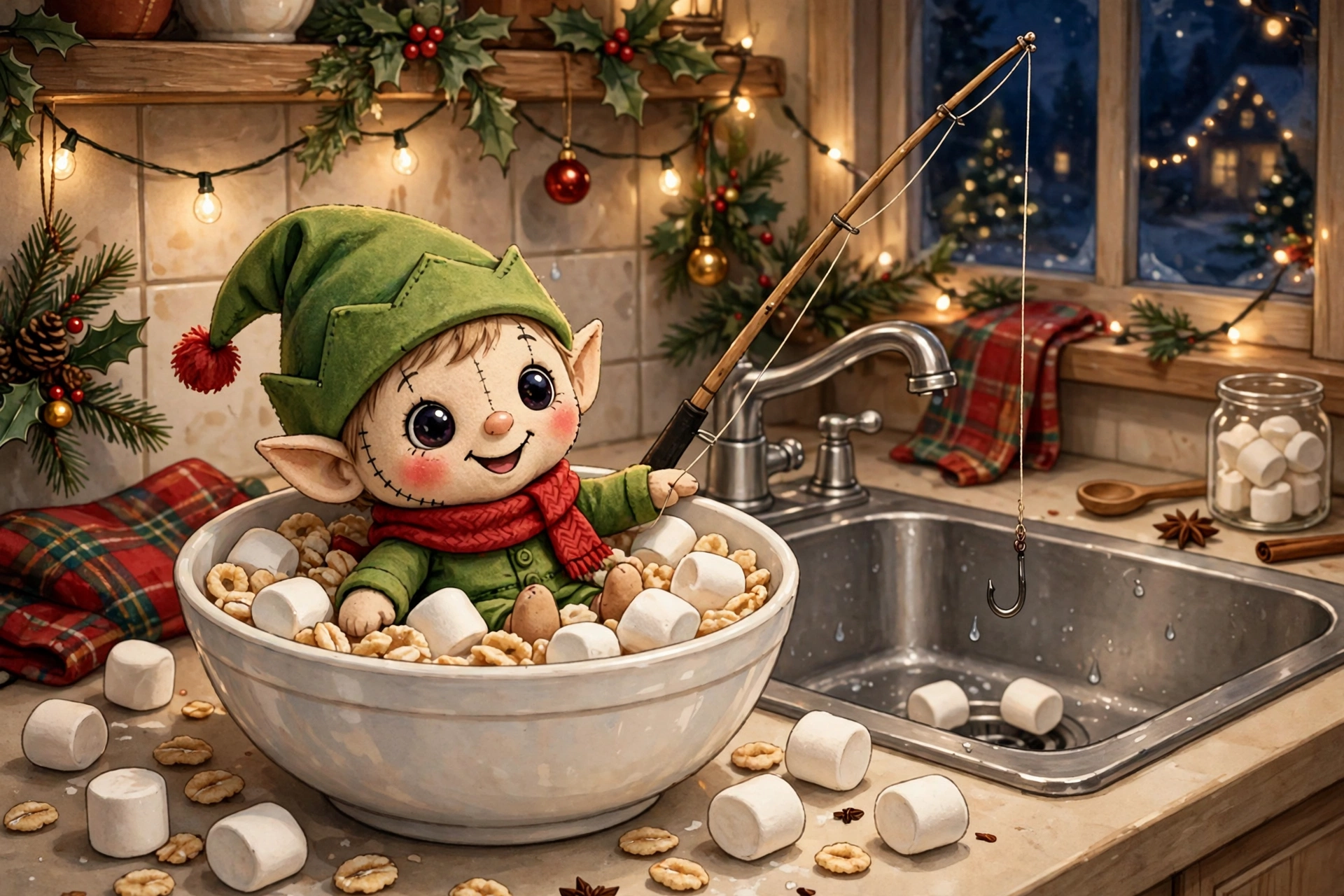
Quick answer: Easy elf ideas are nightly setups that take under five minutes and use things in your home: the elf in a cereal bowl, fishing in the sink, or hiding in the tree. Sort ideas by effort — two-minute setups for school nights, five-minute scenes for calmer evenings, one idea at the weekend — and the month runs without a panic.
The 11 pm problem every elf parent knows
It is the same story in every elf house. The children are asleep, the house is quiet, and a parent suddenly remembers: the elf has not moved. What follows is a tired search of the kitchen at 11:40 pm, trying to invent something clever while half asleep. The next morning the elf is sitting somewhere odd, the children are delighted anyway, and the parent promises to plan better tomorrow.
The secret nobody tells new elf parents is that children do not want clever. They want to find the elf somewhere new, doing something funny, every morning. A simple scene done well beats an elaborate scene done exhausted, every single time. This guide is built on that truth: every idea below is easy, uses things you already own, and can be done in the time it takes to make a cup of tea.
A note on the tradition itself: this is a family game played in thousands of homes, described here in general terms. It is not connected to any official brand or product, and your family's version — including your own rules — is the right one.
The two-minute ideas: for school nights
These are your work horses. They need no preparation, no shopping, and no skill. Keep a mental list of ten, and rotate them on nights when you are tired, busy, or simply forgot until bedtime.
None of these needs a single purchase. That is the point. The elf's magic lives in the surprise, not in the props.
- Cereal bowl swim. Sit the elf in a bowl with a few pieces of cereal around it, like a tiny swimming pool. Add a spoon as a diving board if you are feeling fancy.
- Toilet paper trail. Unroll a little toilet paper from the bathroom to wherever the elf sits, as if it had a wild night. Children find this hilarious, and it takes thirty seconds.
- Fridge shelf sit. Stand the elf on a fridge shelf among the milk and juice, holding a tiny snack. Children love opening the fridge to a surprise.
- Book reader. Lean the elf against a small book, or a stack of books, as if it fell asleep reading. Works on a bedside table or a bookshelf.
- Sock swing. Hang a sock from a chair or a drawer handle and sit the elf inside it like a hammock. Instant, funny, and free.
- Shoe surprise. Tuck the elf into a child's shoe, or a parent's boot, peeking out. The morning shriek is worth it.
- Tree hanger. Hang the elf from a low branch of the Christmas tree by its arms or legs. Classic for a reason: children check the tree first anyway.
- Mirror message. Write a short message on a bathroom mirror in a dry-erase marker — "I hid your socks!" — and sit the elf beside it.
- Mug hide. Stand the elf in a large mug on the kitchen counter. Add a tea bag over the edge for a tiny joke.
- Tape trap. Stick the elf to a wall or a doorframe with a loop of tape, arms out, as if it got stuck. Children love rescuing it.
Easy ideas by room, so you never stand stuck in the hallway
When your mind goes blank at night, stop asking what the elf could do and ask a simpler question: which room am I standing in? Every room in the house holds two or three ready-made scenes, and working room by room stops the slow, tired wander from doorway to doorway. If you are still in your first week, our Elf on the Shelf Arrival Ideas guide covers night one properly; from night two onwards, thinking by room is the fastest way to choose.
Work through the rooms in a rough order and you will not repeat a room two nights running, which is half of what makes the elf feel freshly moved. Kitchen on Monday, bedroom drawer on Tuesday, hallway on Wednesday — the children experience variety even though you only ever used things that were already in front of you.
- Kitchen, kettle spot. Sit the elf on top of the kettle or beside the toaster with a tiny spoon, as if it tried to make breakfast before anyone woke up. It is the first place most families walk to in the morning.
- Kitchen, lunchbox line-up. The night before a school day, sit the elf inside an open lunchbox on the counter, holding a grape or a cracker. Packing the real lunch around the discovery takes a minute longer, and it gets talked about all day.
- Bedroom, pyjama drawer peek. Tuck the elf among folded pyjamas with just its head and hat showing. Keep it to a drawer children already open themselves for clothes, not a drawer of keepsakes.
- Bathroom, toothbrush guard. Stand the elf beside the toothbrush pot, arms folded, as if it is on guard duty. A small note reading "twice a day, please" makes older children groan happily.
- Hallway, coat-hook climb. Hook the elf gently onto a coat hook, or onto the strap of a school bag by the front door. Mornings out are rushed, so a find on the way out sets the tone for the whole walk.
- Living room, remote control throne. Wedge two cushions together as a small throne, sit the elf on it holding the television remote. It reads instantly from the doorway, and clearing it away takes seconds.
The five-minute ideas: for calmer evenings
When you have a little more time, these scenes add a small story without adding stress. Prepare them while dinner cooks or while children brush their teeth, and they still count as easy.
The trick with five-minute ideas is to stop at five minutes. The moment you start building a miniature set, you have left "easy" behind. A scene children can understand in one glance is a scene that works.
- Sink fishing. Fill the sink with a few centimetres of water, float a small bowl as a boat, and give the elf a stick with string as a fishing rod. A couple of small toys can be the "fish".
- Flour snow angels. Sprinkle a little flour on a baking tray and lay the elf in it, arms out, as if it made a snow angel. Wipe-up takes a minute, and the effect is wonderful.
- Marshmallow snowball fight. Scatter mini marshmallows around the elf and a couple of small toys, as if a snowball fight just happened. Children will re-enact it all morning.
- Toilet paper snowman. Wrap the elf loosely in toilet paper like a tiny snowman, with a small carrot-shaped piece of card for a nose. Silly, quick, and very photogenic.
- Puzzle thief. Scatter a few jigsaw pieces around the elf, with one piece "held" in its hands, as if it was playing with the puzzle in the night.
- Drawing on the fridge. Leave a small drawing the elf "made" on a whiteboard or a piece of paper stuck to the fridge — a wonky snowman, a Christmas tree, a self-portrait. Children treasure elf art.
- Movie night. Prop the elf in front of a tablet or a book with a few small toys beside it, plus a tiny bowl of popcorn, as if it watched a film after bedtime.
The weekend ideas: one bigger scene a week
One bigger idea a week is plenty. Weekends give you daylight, energy, and children who are awake to enjoy the build — or rather, to discover it, since the elf "built" it overnight. Save these for Saturdays, when a longer setup feels like fun rather than a chore.
Do the big idea on Saturday night, and let it stay up on Sunday too if children want to keep playing with the story. Nobody checks whether the elf moved twice in a weekend.
- Elf zipline. String a piece of twine across a room, thread it through a small container or a candy cane hook, and sit the elf in it mid-flight. Children love a zipline, and it takes ten minutes at most.
- Baking helper. Set the elf beside a mixing bowl with flour, a wooden spoon and a few cookie cutters, as if it tried to bake in the night. Add a small "mess" of flour for comedy.
- North Pole post office. Pile a few envelopes and a small box near the elf, with one envelope addressed to Santa. Children can add their own letters to the pile.
- Elf spa day. Lay the elf on a flannel with cucumber slices nearby and a tiny towel, as if it treated itself. This one makes adults laugh as much as children.
- Snowball garland. String cotton balls or marshmallows along a piece of thread across a doorway, with the elf "caught" in the middle. Simple, festive, and reusable all week.
A plan for the whole month, without the panic
The reason parents run out of ideas is not a lack of ideas — it is a lack of a plan. Mid-December is when the first week's enthusiasm runs out, so plan the month in three parts before the elf even arrives.
Keep a simple list on your phone: the ideas you have used, and the ones still to try. Crossing them off takes seconds and stops the nightly "what haven't we done?" spiral. And if you do forget a night entirely, use the honest rescue: the elf left a note saying it was too tired from flying to move far, and it is sitting right where it was, resting. Children accept this with great sympathy, and you get a free night.
- Week one: the easy wins. Use the two-minute ideas while the novelty is fresh. Children are delighted by anything in week one, so save your effort.
- Weeks two and three: mix and repeat. Alternate five-minute scenes with old favourites. Children rarely mind a repeated idea if the spot is different — the same cereal bowl joke in a new place feels new.
- Final week: notes and goodbye. Let the elf leave short notes instead of big scenes: a joke, a kindness challenge, a countdown message. Notes are the lowest-effort, highest-delight ideas of all, and they lead naturally into the elf's goodbye letter on Christmas Eve.
The forgotten-night rescue plan, in four calm steps
The original plan in this guide mentions the tired-elf note, and it works. But some mornings need a fuller rescue: the children are already awake, the elf is exactly where it sat yesterday, and there is no quiet minute to fix it before breakfast. Stay calm. Children read your face before they read the scene, and a relaxed parent sells a rescue far better than a perfect hiding place does. A short note does half the rescue work on its own — our Elf on the Shelf Notes Printable guide has copy-ready lines for exactly these mornings, if you want one written before you need it.
One real example, because every elf house has lived it: on a Saturday lie-in, a family realised at the breakfast table that the elf was still on the bookshelf from Friday. While the children watched a cartoon in the next room, the elf quietly moved to the cereal cupboard. When it was found there ten minutes later, the verdict was instant — it had obviously hidden somewhere better for the weekend, because weekends are for cereal. No suspicion, no drama, one cupboard.
- Step one: check the clock, not your conscience. If the children are still asleep, you have not forgotten anything — you are simply doing the setup at 6 am instead of 11 pm. Move the elf somewhere close and easy, and say nothing.
- Step two: if the children are awake but in another room, move the elf then. Bathrooms, bedrooms and the far side of the kitchen all buy you thirty unnoticed seconds.
- Step three: if the elf has already been seen in yesterday's spot, give the stillness a story. It was resting after a long flight, it fell asleep on duty, or it liked that spot so much it stayed. Say it lightly, once, and move on.
- Step four: tonight, set up an hour earlier than usual and put a spare idea on your phone for tomorrow. A rescue is only a problem when it becomes the routine three nights running.
Big laughs, tiny mess: ideas for no-mess households
Flour snow angels and marshmallow snowball fights are wonderful — in a house where someone has the energy to clear them up. In a house with a crawling baby, a dog who eats anything dropped, cream carpets, or a parent simply done with sweeping, the messier classics are off the table, and that is fine. Dry, contained scenes get exactly the same morning reaction, because children react to the elf's situation, not to the debris around it.
If you prefer the whole month planned on paper rather than invented nightly, the Elf on the Shelf Kit guide walks through the full set, and our printables collection gathers the notes, letters and cards in one place. Ten quiet minutes of planning on a Sunday replaces a lot of late-night rummaging, and planning on paper is itself the tidiest elf idea there is.
- Snow globe, no water. Sit the elf inside a large, empty, clear mixing bowl turned on its side, with a pinch of cotton wool at its feet. It looks like a snow globe, and tidying up means putting one bowl back in a cupboard.
- Upside-down reader. Lean the elf against a book that it is holding upside down, as if it read all night without noticing. Older children spot the joke instantly; younger ones helpfully turn the book round for it.
- Shoe queue. Line up three or four family shoes in a neat row by the door and sit the elf at the front, as if it organised them. No mess at all — if anything, the hallway ends up tidier than it started.
- Sunglasses cool. Rest a pair of doll's sunglasses, or a child's own sunglasses, on the elf's face and sit it by a window, sunbathing. One prop, no crumbs, and very easy to photograph.
- Tissue blanket. Lay the elf on a tissue box with one tissue draped over it as a blanket, as if it has a small winter cold. Children fuss over a poorly elf with great seriousness, and the whole scene goes in the bin in one piece.
Ideas for more than one elf, and for older children
Two elves double the fun and halve the planning, because they can interact: one fishing while the other watches, one hiding while the other seeks, one "caught" in a jar while the other tries to free it. Children love elf friendships, and a pair of elves gives you twice the scene with the same props.
Older children, around eight and up, enjoy a different kind of elf game: puzzles, mysteries and challenges. The elf can leave a riddle, a treasure map, or a scavenger hunt list. It can "move" something small in the house and leave a clue about where it went. These ideas take no more time than a simple scene, but they respect an older child's intelligence — and they keep the tradition alive a few years longer.
For younger children, keep scenes at eye level and within reach of their gaze: low shelves, tables, the bottom of the tree. An elf hidden too cleverly is an elf never found, and a morning without a find is a disappointed child. Easy to find beats cleverly hidden, always.
Love these? The printable Elf Notes & Letters Pack ($3) has the arrival letter, goodbye letter, 24 daily notes and the official report card — and the Elf + Advent Bundle ($4) adds 25 Advent activity cards. See them on our Printables page.
When December ends, give the season a proper last morning rather than letting the elf simply vanish between one breakfast and the next: our Elf on the Shelf Goodbye Letter guide is the specific next page to open, with copy-ready letters to leave beside the elf on its final night.
Try it on MerryHub
- Try the Elf Name Generator
- See the printable cards & games pack
- Elf on the Shelf Arrival Letter
- Elf on the Shelf Notes Printable