Quick answer: An elf arrival works best when it is simple, seen first thing in the morning, and paired with a short letter that explains who the elf is and what happens next. Pick one arrival from this guide, set it up the night before in under 15 minutes, and leave the letter beside the elf.
Pick your arrival by how much time you have
Start here, not with a list of 75 ideas. The arrival that works is the one you will actually set up at 11 pm, tired, with a house that still needs tidying. So pick by effort, honestly. If you have two minutes, the elf simply appears somewhere new, with the letter beside it. On the mantel. On top of the cereal box. Sitting in a shoe by the door, as if it just walked in. Children do not grade the set design on night one. They grade the surprise: yesterday there was no elf, today there is. If you have ten minutes, give the arrival a small story. A suitcase by the front door. A balloon tied to the elf's wrist, floating from the ceiling. A plate with two biscuits and a note saying the journey was long. Ten minutes buys you a scene, and a scene buys you a gasp. If you have a free evening and you enjoy this sort of thing, go bigger: a North Pole breakfast table, a tiny suitcase packed with miniature clothes, a trail of fake snow from the window to the tree. But know this before you start — a big night one sets a bar. Night two still has to happen, and it will be a school night. Big is wonderful. Big is not required. One more decision, before anything else: has your elf been named yet? If not, that naming is part of night one. Our Elf Name Generator gives you a name in seconds, and the letter below has a blank for it. A named elf is a family member. An unnamed elf is a decoration.
When the elf should arrive
Most families welcome a returning elf in the last week of November or on 1 December. The official tradition calls this Scout Elf Return Week, running from 23 November to 1 December, and the official Scout Elf Return Week guide is the place to check the dates for this year. First-time families can pick any day that suits them — there is no wrong date, only a date you can sustain for the rest of December. Set the scene the night before, after the children are asleep. Morning is the reveal, not the setup. If your children wake early, put the elf somewhere they will find it without help: the kitchen table, not the top of a bookshelf they cannot reach. The best arrivals are found, not pointed out. And if you are late? If it is 5 December and the elf is still in a box in the loft? Bring it out anyway, with a letter that says the journey took longer than expected. Children forgive a late elf far more easily than parents forgive themselves for one. A shorter December is still a December.
Twelve arrivals, grouped by effort
Here they are, plain and usable. Each one takes the time stated, using things most houses already have. Two-minute arrivals:
Ten-minute arrivals:
Bigger arrivals, for a free evening:
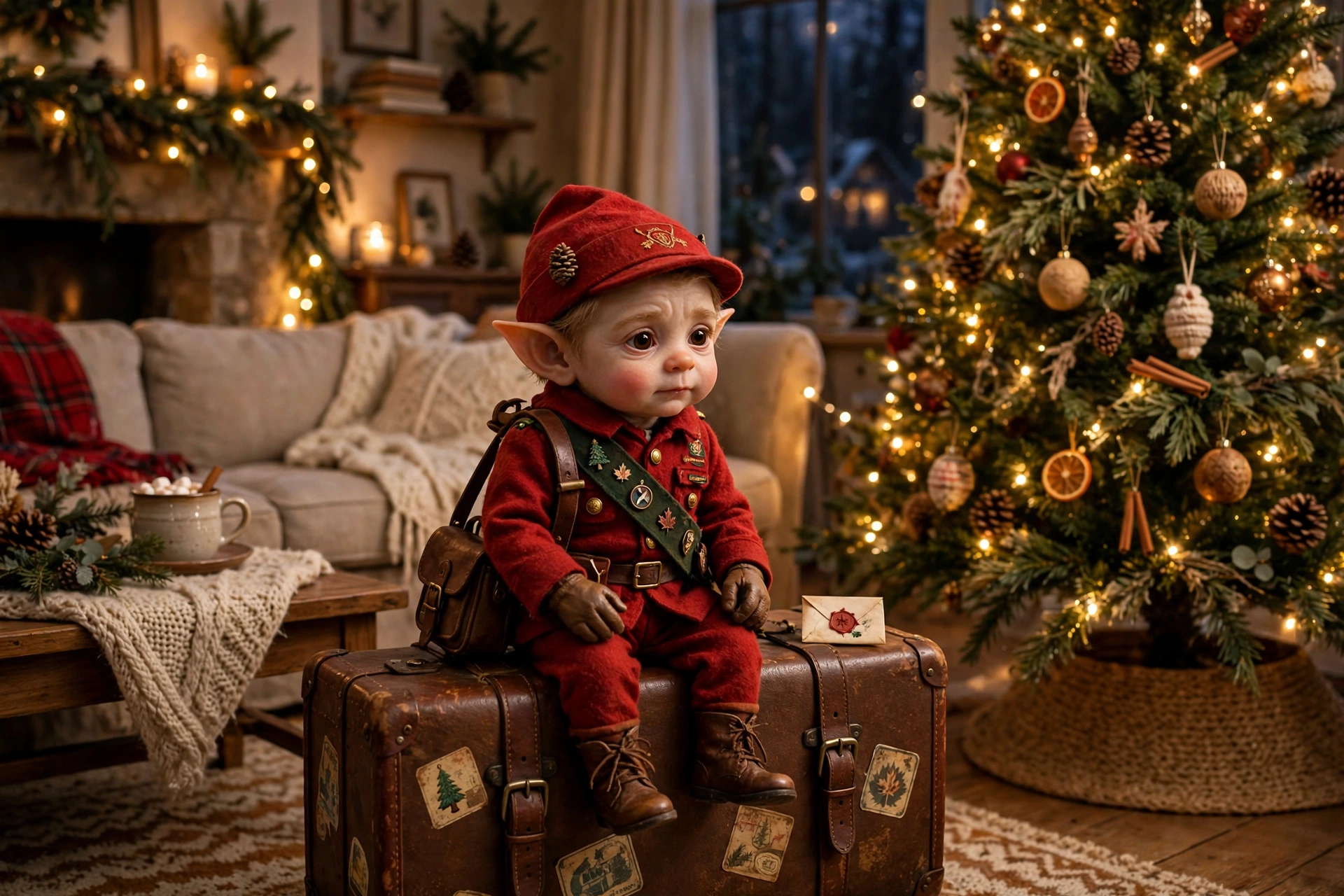
- The suitcase at the door: elf sitting on a small bag by the front door, letter on top. The story writes itself — it just arrived.
- The breakfast table guest: elf perched on a chair at the breakfast table, with a tiny plate beside it. Breakfast becomes the discovery.
- The tree ornament: elf hanging from a low branch of the tree, holding one bauble. Works even if the tree only went up yesterday.
- The balloon float: one helium balloon, string tied loosely around the elf's waist, elf dangling from the ceiling over the kitchen table. Check the string is loose enough to undo without a fight.
- The snow trail: cotton balls or flour in a short trail from a window to the elf's spot. Flour looks better and vacuums up worse; cotton balls are the calmer choice.
- The North Pole breakfast: doughnuts or pancakes on the table, a small sign saying "I brought breakfast", elf sitting with a fork. This one needs morning timing — set the table, not the food, the night before.
- The book stack: elf sitting on a pile of Christmas books, letter tucked into the top book. Quiet, warm, and it starts a bedtime reading habit for the month.
- The cookie confession: elf beside a plate with one bitten biscuit and crumbs, note saying the journey made it hungry. Children find this one hilarious, every single year.
- The zip line: string across the living room, elf clipped on with a peg, mid-journey. Test the slide before bedtime — an elf that does not slide is just an elf on a string.
- The snow angel: flour or powdered sugar on a tray, elf lying in the middle with arm marks. Do it on a tray, not the floor, or you will be finding flour in January.
- The cinema night: elf on the sofa with a small bowl of popcorn and a remote, facing the television. Leave a note saying it watched a Christmas film while everyone slept.
- The advent pairing: elf arriving beside the advent calendar, holding the first card or chocolate. This one pays off twice, because it ties the elf to a daily habit you already planned.
A copy-ready arrival letter
A letter turns a scene into a story. Copy this one, fill in the two blanks, and leave it beside the elf. It works for a first visit and for a returning elf — just change the first line if your elf has visited before. "Hello! I have arrived all the way from the North Pole, and I am so happy to be back in your home. My name is ____, and Santa asked me to watch over your family and tell him about all the kind and funny things you do. I will fly back to the North Pole every night to report, and every morning I will be hiding somewhere new for you to find. Please look with your eyes, not your hands, so my magic stays strong. I cannot wait for December with you. Love, ____" Read it aloud on the first morning, slowly, even if the children can read it themselves. The letter read aloud is the moment. The letter left on the table is just paper. If your elf is arriving for the very first time, add one sentence at the top: "This is my first visit, and I have been so excited to meet you." That single line answers the question every first-timer asks, which is whether this elf is really theirs now.
For first-timers, returning families, and nervous children
First-timers have one job on night one: explain the rules, kindly. The elf watches during the day, flies to Santa at night, and must not be touched or the magic fades. Say it in the letter, say it aloud, and then move on. A rule explained once, warmly, holds. A rule repeated anxiously all December does not. Returning families have a different job: make this year feel new without rebuilding the whole tradition. Change one thing. A new arrival scene, a new name for a second elf, a letter that mentions something real from last year — "I remember the snowman you built" beats any new prop. Children notice continuity more than novelty. And if a child is nervous — if a watching elf sounds less like fun and more like being watched — soften it on night one. In your family, the elf can be a reporter of kind things only. Say so, in the letter and out loud: this elf tells Santa about the good stuff. Some families skip the naughty-list language entirely, and the tradition works just as well. The elf is supposed to add delight, not worry. If it adds worry, change the rules. You are in charge of this tradition, not the other way round.
An arrival a toddler can enjoy, and one an older child will respect
Toddlers, roughly two to four, need an arrival that is low, soft and impossible to misunderstand. Put the elf at their eye level — on a small chair at a little table, or sitting in the middle of the rug with the letter propped in front of it — and keep every prop too big to be a worry and too plain to be pulled apart. Read the letter aloud in your normal voice, point once, and then let the toddler do what toddlers do: stare, grin, and carry on with breakfast while glancing back every minute. Do not chase a bigger reaction. A two-year-old who keeps checking the elf is still there is having exactly the right morning.
An older first-timer, say eight to ten, needs almost the opposite arrival: less cute, more mysterious. Let the elf arrive holding a sealed envelope with the child's name on it, inside which is one line — "I only report excellent teamwork, daring rescues and very good jokes." In one family, an elf that arrived on a gaming chair with that note turned a child who had announced he was far too old for elves into the person who checked the chair first every morning. Older children do not want to be fooled; they want to be let in on a game worth playing. Give them a role — chief elf-spotter, keeper of the letter — and the arrival lands.
No tree yet, small flat, no spare corner: arrivals that need almost no space
Many arrivals in lists like this one quietly assume a big living room, a tree already up, and a mantelpiece. Plenty of families have none of those in the last week of November: the tree goes up in mid-December, the flat is small, or the elf is arriving in a home that is mid-decorating. Space is not what makes an arrival. A windowsill, a fridge door and the inside of a stocking are each enough room for the whole event, letter included.
- The windowsill traveller. Sit the elf on the kitchen windowsill beside a small mug, as if it stopped for a warm drink on the way in. It is the spot children pass first for a glass of water in the morning.
- The early stocking. Hang one stocking early — tradition can bend — and tuck the elf inside it with just its head and hat showing, letter folded underneath. No tree required, and the stocking earns its keep twice.
- The cookbook shelf. Sit the elf between cookbooks or on the spice shelf, holding a wooden spoon. Kitchens are warm, lived-in and visited first thing, which makes them natural arrival rooms in a small home.
- The inside wreath. If a wreath hangs on the inside of the front door, rest the elf in its lower curve, letter tied loosely to the ribbon. Keep it on the inside, so the morning find happens at home and not in the hallway outside.
What happens on night two
Night one is the easy night. Night two is where most elf traditions quietly stall, because the parent who staged a balloon float at midnight now has to do something again, tomorrow, also tired. So decide night two tonight, while you are setting up night one. The simplest bridge: the elf leaves a note saying "I loved my breakfast — tomorrow I will be somewhere high" or "find me near something red". A note that promises tomorrow's game is worth more than a second big scene. It turns the elf from a one-night event into a morning habit. For the full month, our Easy Elf on the Shelf Ideas guide sorts nightly setups by effort — two-minute, five-minute and weekend — so you can pick tomorrow's setup in the same minute you read tonight's note. And if you want the whole month planned rather than improvised, the printables page holds the Elf on the Shelf Kit, which carries the arrival letter, 24 daily notes and the advent cards in one set. The kit is the planned version of this guide; this guide is the free version you can start tonight.
When a grandparent or another grown-up stages the arrival
December often starts away from home: a first weekend with grandparents, an aunt who hosts while parents work late, a childminder who has kindly agreed to be part of the magic. Handing the arrival to another grown-up works beautifully, but only if the handover is written down. What feels obvious to you — the elf's name, the eyes-not-hands rule, the places the elf never goes — is brand-new information to someone who received a doll and a letter in a carrier bag.
Keep the handover to one small card and two links. On the card: the elf's name, the one house rule, where it should be found in the morning, and one place to avoid — a dog's bed, a steamy bathroom shelf, anywhere a pet sleeps. Then send this guide for the scene itself, and the Elf on the Shelf Arrival Letter page for a letter that can be printed and left beside the elf, so nobody has to invent handwriting that is not theirs. If the stay runs longer than one night, the full Elf on the Shelf Kit guide and the daily messages in our Elf on the Shelf Notes Printable guide give the stand-in grown-up a second and third morning without a single panicked phone call to you.
The night-one checklist
Before you go to bed, run through this, fast:
That is the whole job. One scene, one letter, one plan for tomorrow. The rest of December can be as simple or as spectacular as your energy allows — but it starts here, tonight, in under 15 minutes.
- Elf placed where it will be found in the morning, not where it looks best in a photo.
- Letter beside it, names filled in, read-through once for spelling.
- Night two decided — a note, a spot, or at least an idea written on your phone.
- Props that could fall, spill or be eaten by a pet moved out of reach.
- Camera charged, if you want the morning photo, because the morning will be fast.
Your next step tonight
Pick one arrival from the list above, write the letter, and set the scene after bedtime. Then, before you sleep, open our Easy Elf on the Shelf Ideas guide and pick tomorrow night's setup — two minutes now saves a midnight scramble tomorrow.